
Quick Summary
When unexpected leaks or burst pipes threaten property structures, securing prompt water damage restoration in West New York is vital to prevent secondary structural rot and rapid mold development. Wade's Restoration provides 24/7 rapid emergency response across Hudson County, utilizing advanced extraction tools, thermal moisture mapping, and targeted structural drying to effectively salvage building materials. Readers will understand standard mitigation phases and restoration cost factors, enabling them to contact Wade's Restoration 24/7 dispatch line immediately to schedule a free visual inspection.
Water Damage Restoration in West New York – Fast 24/7 Response
When a pipe bursts or water intrudes into a property, water damage does not wait for normal business hours. In multi-story and residential buildings, water follows gravity, seeping through flooring, pooling between joists, and affecting ceilings and living spaces below.[1]
Stopping water damage requires prompt action and specialized equipment. Emergency response teams, such as those from Wade’s Restoration, utilize extraction equipment, moisture detection tools, and drying systems to help stabilize properties and mitigate moisture issues.[3] See also Water Damage Restoration in Jersey City | Call Now-10% Off | Same-Day Service | Free Estimate.
Water Mitigation for Local Properties
In residential and multi-story structures, water intrusion can quickly affect multiple building assemblies. Moisture can enter interstitial spaces between floors and behind walls. Without proper drying and moisture extraction, trapped moisture can cause structural issues and create conditions conducive to mold growth within a general 24-to-48-hour risk window, as recognized in FEMA guidance.
What Does Water Damage Restoration Cost?
Water damage restoration costs generally fall within an approximate range of $1,300 to $6,387. Actual project costs depend on the water source, the square footage affected, and the extent of structural materials involved.
Key Factors That Influence Costs
- Water Spread: Water traveling across multiple levels or into subfloors requires additional equipment and monitoring.
- Material Types: Hardwood floors, subflooring, and plaster or drywall require different drying techniques and timeframes.
- Water Source: Clean water from supply lines requires different handling than contaminated water from drain backups or outdoor runoff.
Insurance Claims and Coverage
Standard homeowners insurance policies typically cover sudden and accidental water damage, such as internal pipe bursts or appliance failures. Damage resulting from external flooding generally requires a separate flood insurance policy. Documenting moisture levels and damage with professionals like Wade’s Restoration can assist during the insurance claim process.[2]
Restoring Building Materials After Water Intrusion
Need water damage restoration in West New York?
We’re available now - call for a fast, free estimate.
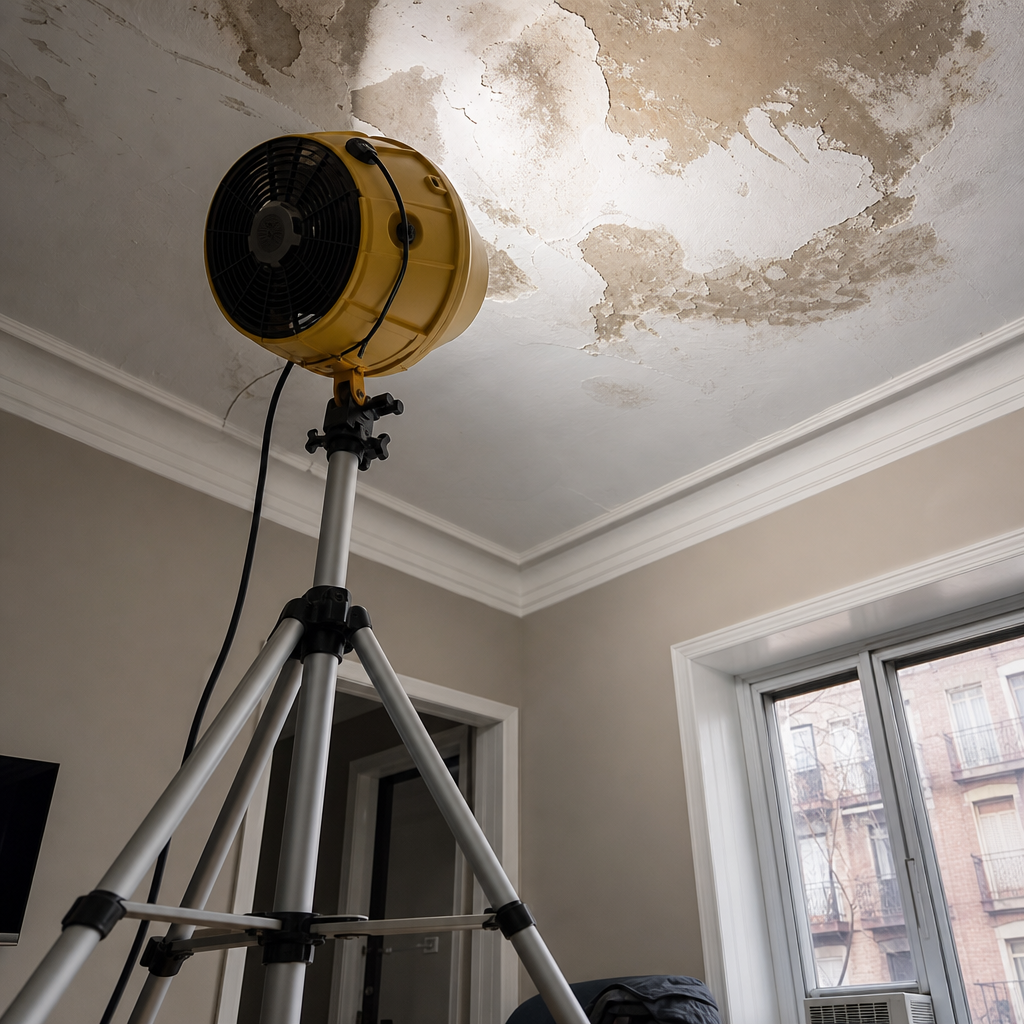
Targeted drying techniques can often help salvage materials when mitigation begins promptly.[5]
Hardwood Floor Drying
When hardwood floors absorb water, moisture can cause cupping or warping. Specialized drying systems and commercial dehumidifiers used by Wade’s Restoration can draw trapped moisture from flooring assemblies to assist in returning wood to acceptable moisture levels.
Addressing Ceilings and Structural Elements
Ceilings and framing elements can hold moisture after water leaks from above. Moisture mapping and controlled airflow help dry structural components and wall cavities before permanent damage occurs.
The Water Extraction and Mitigation Process
Water mitigation typically follows standard industry procedures to stabilize the property and dry affected materials.
Phase 1: Inspection and Moisture Mapping
Technicians at Wade’s Restoration use moisture meters and thermal imaging to identify the path of water through walls, floors, and enclosed spaces.
Phase 2: Water Extraction
Removing standing water is a primary step to expedite structural drying. Extractors and pumps remove bulk water from affected areas.
Phase 3: Antimicrobial Treatment and Air Filtration
Antimicrobial treatments and air filtration systems may be applied to affected areas to treat surfaces and maintain air quality during drying.
Phase 4: Structural Drying and Monitoring
Air movers and dehumidifiers are placed to remove moisture from structural materials, with conditions monitored until standard dry levels are reached.
Phase 5: Repairs and Restoration
After thorough drying is confirmed, necessary repairs are completed to return the space to its pre-damage condition.
Frequently Asked Questions
How quickly should an emergency water restoration team arrive?
A rapid response is critical when water damage occurs to prevent moisture from spreading to adjacent areas. While no specific arrival timeframe is guaranteed, prompt emergency dispatch is recommended.
How much does water damage restoration cost?
Restoration projects typically fall within a general range of about $1,300 to $6,387, depending on the severity of the damage, the category of water, and the specific materials affected.
Will insurance cover water mitigation?
Standard homeowners insurance policies generally cover sudden and accidental water damage, such as burst pipes. However, external flood damage typically requires a separate flood insurance policy.[4]
How quickly can mold develop after water intrusion?
According to general FEMA guidelines, mold can potentially begin to develop on damp organic materials within a 24-to-48-hour window under favorable conditions. Prompt water removal and drying help reduce this risk.
What standards do restoration technicians follow?
Professional restoration teams typically follow established industry drying protocols and guidelines to address water damage safely and effectively.
If your property is experiencing water intrusion, contact a local water restoration service like Wade’s Restoration promptly to assess the damage and begin mitigation.
Need water damage restoration in West New York?
We’re available now - call for a fast, free estimate.
Sources
- Section 5. Risk Assessment – nj.gov (2010)
- Delaware River Basin Commission|Flood Information – nj.gov (2006)
- [PDF] Section 5. Risk Assessment – NJ.gov – nj.gov (2012)
- Flood Event Summaries – National Weather Service – weather.gov (2020)
- HUDSON COUNTY – nj.gov (2021)
Related reading: Water Damage Restoration in Weehawken – Call Now-10% Off – Same-Day Service – Free Estimate
Related reading: Water Damage Restoration in Bayonne – 10% Off & Free Estimate – Same-Day Service
Related reading: Water Damage Restoration in Harrison | 10% Off & Free Estimate | Same-Day Service
Water Damage Restoration in Nearby Cities
We also serve the communities around West New York:
- Water Damage Restoration in Financial District
- Water Damage Restoration in Hoboken
- Water Damage Restoration in Long Island City
- Water Damage Restoration in Lower Manhattan
- Water Damage Restoration in Midtown Manhattan
- Water Damage Restoration in Midtown West
- Water Damage Restoration in North Bergen
- Water Damage Restoration in Secaucus
Frequently Asked Questions
How long does the structural drying process typically take for local properties?
Structural drying generally takes between 3 to 5 days, depending on the building materials involved and the extent of water penetration. Wade's Restoration uses advanced thermal mapping and daily moisture readings to verify that framing, subfloors, and drywall are completely dry before repairs begin.
Can hardwood floors be salvaged after sudden water damage?
Yes, hardwood floors can frequently be saved if professional extraction begins before wood fibers permanently cup or warp. Wade's Restoration utilizes specialized floor mat drying systems and commercial dehumidifiers to draw trapped moisture from deep within the wood assemblies.
How do I schedule an emergency visual inspection in West New York?
Property owners can call Wade's Restoration directly via their 24/7 emergency dispatch line to request an immediate response. Their certified local team provides a free visual inspection to evaluate moisture spread and quickly start the extraction process.
About the author
 |
Daniel Preston Daniel Preston is a certified structural drying expert with over 12 years of experience in disaster restoration across the New York metropolitan area. Holding an Environmental Science degree from Rutgers University, he specializes in rapid response strategies for water damage mitigation, mold remediation, and fire recovery. Daniel combines his technical knowledge with a practical approach to help property owners navigate the complexities of emergency restoration and insurance claims. |
Water damage, flood, or mold emergency?
We’re available now - call for a fast, free estimate.
Call Now - Free Estimate