
Quick Summary
When plumbing failures, pressurized riser bursts, or urban flooding threaten high-density properties, rapid water damage restoration in Midtown Manhattan is essential to prevent widespread multi-floor destruction. Wade's Restoration provides 24/7 emergency water mitigation, targeted cavity drying, and detailed insurance documentation tailored specifically to the complex building logistics of Midtown Manhattan. Property owners will learn how structural drying and moisture mapping protect building assets and can contact Wade's Restoration for immediate 24/7 extraction or a free visual inspection.
Water Damage Restoration in Midtown Manhattan – Emergency Water Mitigation
When an emergency pipe bursts or a mechanical riser fails on an upper floor, Wade’s Restoration provides water damage restoration in Midtown Manhattan. We extract standing water, contain leaks, and dry out affected structural assemblies to protect building interiors.
New York City flood-risk mapping and local reports highlight documented flood risks and chronic street flooding in Midtown, while internal plumbing issues also pose water hazards. Pressurized risers and commercial plumbing failures can spread water through utility chases, drop ceilings, and subfloors. We work with high-capacity extraction and drying equipment to stabilize building materials and manage moisture.[2] See also Water Damage Restoration in Jersey City | Call Now-10% Off | Same-Day Service | Free Estimate.
We provide moisture logs, thermal imaging data, and detailed documentation to assist with insurance claims. Contact our local team to discuss emergency services or schedule a visual inspection.
Commercial and Multi-Story Water Damage Mitigation
A water issue in a Midtown building requires an organized plan to manage moisture:
- Water Extraction: Extractors remove standing water from floors and affected building areas.
- Structural Drying: Dehumidifiers and air movers draw trapped moisture out of subfloors, drywall, and structural framing.
- Moisture Mapping and Daily Logs: Moisture meters and monitoring tools track drying progress to verify that structures return to dry standards.
According to the New York City Hazard Mitigation Plan, 60% of buildings in the city’s 1 percent annual chance floodplain are projected to sustain damage during a severe flood scenario. In Midtown, whether water comes from documented heavy rain events or internal mechanical failures, structural stabilization protects property value and business operations.[1]
Emergency Water Damage Response in Midtown Manhattan
Our crews dispatch to respond to Midtown calls as promptly as local conditions allow. In high-density commercial corridors, prompt action is key: unchecked water can track through floor penetrations and damage spaces beneath.
Navigating Midtown Traffic and Building Logistics
Getting mitigation equipment into a Midtown building requires local coordination. Documented city 311 data highlights chronic street flooding complaints in Midtown South and surrounding neighborhoods during heavy rain, which can complicate traffic across major cross-streets. Response teams must anticipate these conditions while coordinating with building management.[5]
Upon arrival, securing freight elevator access and staging equipment near affected areas is essential. By working with building superintendents and facility staff, Wade’s Restoration teams coordinate access to set up extraction and drying gear efficiently.
Moisture Containment and Stabilization
Water in multi-story structures moves downward rapidly through building penetrations and slab cores. Water line failures can cause substantial building disruptions, as seen in past Midtown infrastructure incidents. When providing water damage restoration in Midtown Manhattan, technicians focus on standard containment and mitigation steps:[4]
- Supply Isolation: Verifying the main supply or riser branch is isolated to stop incoming water.
- Water Interception: Containing and extracting water at vertical shafts, elevator areas, and stairwells to limit spread to lower floors.
- Surface and Cavity Water Removal: Extracting water from flooring and structural cavities before moisture causes deeper saturation.
What Factors Affect Water Damage Restoration Costs in Midtown Manhattan?
Need water damage restoration in Midtown Manhattan?
We’re available now - call for a fast, free estimate.
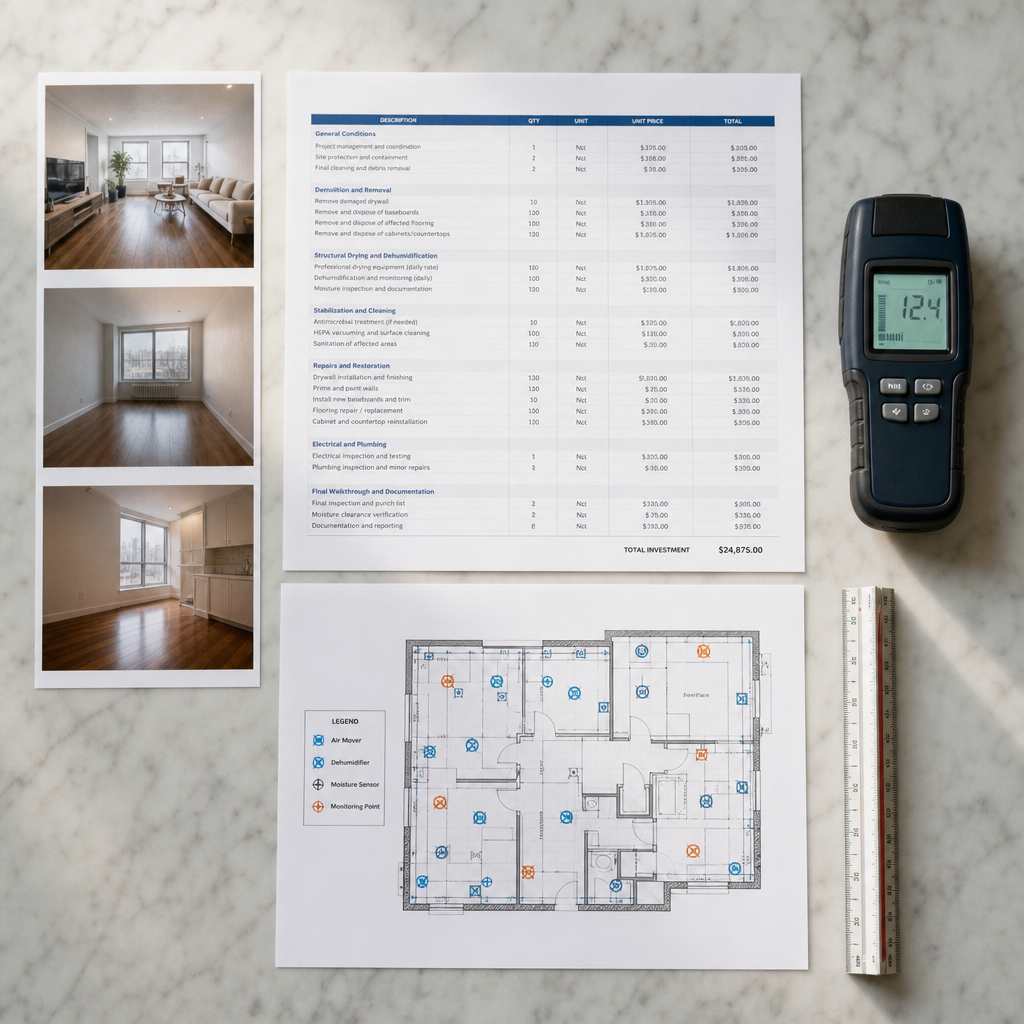
The cost of restoring water damage in Midtown Manhattan depends on the water source (clean supply lines versus contaminated water), how far water traveled through the structure, the drying time required, and building logistics such as service elevator access.
Midtown Restoration Considerations
Multi-floor water incidents require thorough extraction and drying at every affected level. Citywide risk assessments emphasize the economic impact of major water events; the NYC Hazard Mitigation Plan estimates that a 1 percent annual chance flood could result in roughly $15 billion in damage in Manhattan alone. Aging municipal infrastructure also contributes to water hazards, as illustrated by general water main breaks and disruptions across Midtown. Timely water damage restoration from Wade’s Restoration helps property owners manage repair costs and downtime.[3]
| Restoration Step | Clean Water (Category 1: Supply Lines) | Grey Water (Category 2: Appliance Overflow) | Black Water (Category 3: Sewage / Street Flood) |
|---|---|---|---|
| Moisture Assessment | Moisture meters and thermal imaging | Moisture meters and thermal imaging | Moisture meters and contamination assessment |
| Extraction & Structural Drying | Direct extraction and dehumidification | Targeted extraction and structural drying | Complete extraction, material removal, and sanitation |
| Building Containment | Standard airflow containment | Containment barriers | Isolation barriers and negative air filtration |
| Cleaning and Treatment | General surface cleaning | Targeted sanitation | Full decontamination |
Insurance Claim Documentation
Standard commercial property and homeowners policies typically cover sudden and accidental internal water damage, such as plumbing failures, while external street flooding generally requires specific flood coverage. We document the mitigation process to support your claim:
- Moisture Records: Technicians record psychrometric readings and moisture levels to identify affected materials.
- Itemized Scope of Work: We produce detailed documentation and mitigation scopes.
- Daily Drying Logs: Technicians log regular moisture readings to verify that materials reach target dry standards before drying equipment is removed.
Drying and Moisture Management in Multi-Story Buildings
Managing water damage in multi-story properties involves tracing moisture paths, removing standing water, and setting up drying equipment to pull moisture from building materials.
Managing Plumbing Leaks and Multi-Floor Moisture
When an internal pipe breaks on an upper floor, gravity pulls water through perimeter walls, electrical conduits, and floor penetrations. Technicians address this moisture through general mitigation procedures:
- Moisture Mapping: Technicians assess walls and ceilings using moisture meters and thermal imaging to locate trapped moisture.
- Cavity Drying: Introducing dry air into enclosed wall spaces aids in drying interior framing.
- Multi-Floor Extraction: Crews deploy extraction equipment across affected levels to remove standing water and prevent further saturation.
In-Place Drying and Material Removal
Depending on material condition and water category, technicians determine whether materials can be dried in place or require removal to facilitate drying of the underlying structure.
| Drying Approach | Method Description | Intended Outcome |
|---|---|---|
| In-Place Drying | Dehumidification and targeted airflow applied directly to structural surfaces | Dries materials in place when structurally sound |
| Material Removal | Removal of unsalvageable finishes and water-logged materials | Allows direct access to dry the underlying subfloor and framing |
Managing Moisture in Ceiling Assemblies and Enclosed Spaces
Documented flood risks and chronic street flooding in Midtown illustrate the broad potential for water intrusion across the borough, while mechanical backups inside buildings present similar risks. Moisture trapped inside suspended ceilings and enclosed plenums requires prompt drying to prevent environmental concerns.
During mitigation in Midtown properties, Wade’s Restoration technicians remove saturated porous materials and set up drying systems to promote clean air circulation while structural components dry.
Frequently Asked Questions
How much does water damage restoration cost in Midtown Manhattan?
Costs depend on the water category, the extent of structural migration across floors, material types, and building access logistics. A localized clean-water leak addressed promptly generally costs less than extensive multi-floor water damage or contaminated flooding.
Does property insurance cover water damage in Midtown?
Most commercial and homeowners policies cover sudden and accidental internal water incidents, such as ruptured supply lines. External street flooding typically requires separate flood insurance. Thorough documentation and daily drying logs support the claims review process.
How do crews coordinate building access during an emergency?
Restoration teams coordinate with building management, security, and facility engineers to confirm access protocols, loading dock availability, and freight elevator use for equipment staging.
How does moisture affect indoor environments after a water leak?
Excess moisture left in drywall, flooring, or ceiling cavities can lead to mold development and indoor air quality concerns. Timely water extraction, structural drying, and continuous dehumidification eliminate excess moisture to maintain a stable indoor environment.
To address water intrusion and begin drying, contact Wade’s Restoration for emergency water extraction or to schedule a property inspection.
Need water damage restoration in Midtown Manhattan?
We’re available now - call for a fast, free estimate.
Sources
- Buildings | NYC.gov – SIRR- CH 1www.nyc.gov › sirr › downloads › pdf › Ch4_Buildings_FINAL_singles – nyc.gov (2030)
- Street Flooding Events Measured by FloodNet Sensors – catalog.data.gov (2026)
- Annual Claims Report – comptroller.nyc.gov (2023)
- Chapter 1: EXECUTIVE SUMMARY – nyc.gov (2013)
- East Side Coastal Resiliency Updated Benefit-Cost Analysis – nyc.gov
Related reading: Water Damage Restoration in Long Island City – Call Now-10% Off – Same-Day Service – Free Estimate
Related reading: Water Damage Restoration in Lower Manhattan – 10% Off & Free Estimate – Same-Day Service
Related reading: Water Damage Restoration in Bayonne – 10% Off & Free Estimate – Same-Day Service
Water Damage Restoration in Nearby Cities
We also serve the communities around Midtown Manhattan:
- Water Damage Restoration in Financial District
- Water Damage Restoration in Harrison
- Water Damage Restoration in Hoboken
Frequently Asked Questions
How does Wade's Restoration dry vertical utility chases and wall cavities without extensive demolition?
Technicians use thermal imaging and deep moisture probes to map trapped water, then deploy targeted cavity drying equipment that injects dry, heated air directly behind walls and ceiling plenums. This process allows Wade's Restoration to thoroughly stabilize interior structural framing while minimizing unnecessary tear-out of expensive architectural finishes.
How quickly must water be extracted after an upper-floor pipe burst to prevent structural mold growth?
Water extraction and active dehumidification should begin within 24 to 48 hours to prevent mold colonization within drywall, subflooring, and insulation. Wade's Restoration provides 24/7 emergency dispatch across Midtown Manhattan to rapidly intercept multi-floor water migration and restore safe indoor air quality.
What specific documentation does Wade's Restoration provide for Midtown commercial insurance claims?
Wade's Restoration delivers detailed daily psychrometric drying logs, infrared thermal imaging scans, moisture mapping records, and an itemized mitigation scope of work. This documentation clearly proves structural dry standards were met, helping building owners and property managers expedite claim approvals.
About the author
 |
Daniel Preston Daniel Preston is a certified structural drying expert with over 12 years of experience in disaster restoration across the New York metropolitan area. Holding an Environmental Science degree from Rutgers University, he specializes in rapid response strategies for water damage mitigation, mold remediation, and fire recovery. Daniel combines his technical knowledge with a practical approach to help property owners navigate the complexities of emergency restoration and insurance claims. |
Water damage, flood, or mold emergency?
We’re available now - call for a fast, free estimate.
Call Now - Free Estimate