
Quick Summary
Water damage restoration in Midtown West requires rapid structural containment to prevent water from quickly migrating through high-rise mechanical risers, porous concrete slabs, and multi-unit residential spaces. As an IICRC-certified specialist, Wade's Restoration utilizes non-destructive vacuum floor mats, targeted cavity drying, and comprehensive moisture logging to preserve high-value finishes while managing strict Co-op compliance and insurance claims. Property owners will understand how to navigate complex Manhattan water losses and can contact the 24/7 emergency dispatch team immediately for fast water extraction and a free on-site visual inspection.
Water Damage Restoration in Midtown West – Fast Response
When a supply line snaps on the twenty-fourth floor or storm runoff breaches a ground-floor retail space along 10th Avenue, water does not wait. In high-density Manhattan neighborhoods like Midtown West, a single plumbing failure quickly turns into a multi-floor emergency. Water travels down pipe chases, pools on concrete subfloors, and leaks through plaster ceilings into the apartments below. You need an experienced, locally staged crew like Wade’s Restoration on-site immediately to stop the spread, protect the building envelope, and handle the recovery process from start to finish.[5]
Prompt local response is critical to navigate strict Co-op and condo alteration rules, protect building infrastructure, and save original hardwoods, custom cabinetry, and historic plaster using targeted in-place drying instead of unnecessary demolition. See also Water Damage Restoration in Jersey City | Call Now-10% Off | Same-Day Service | Free Estimate.
Quick Answer: Emergency Restoration in Midtown West
Professional water damage restoration in Midtown West centers on rapid containment, continuous moisture mapping, and non-destructive drying. Water migrates rapidly down shared mechanical risers in high-rise buildings, making rapid extraction essential. While some dense urban restoration services aim for 60-minute arrival, same-day arrival within a few hours is more typical. Expert crews extract standing water, deploy specialty floor mat systems, manage freight elevator logistics, and provide clear moisture logs formatted for insurance adjusters.[4]
Manhattan properties present distinct engineering hurdles: vertical plumbing stacks, porous concrete slabs, pre-war structural timber, and strict building board regulations. Because official city hazard materials identify Manhattan as the borough facing the highest flood damages in a modeled 1 percent annual chance flood scenario, mitigating water intrusion properly protects both individual units and building-wide real estate value.[1]
How quickly can emergency water damage restoration crews arrive in Midtown West?
Need water damage restoration in Midtown West?
We’re available now - call for a fast, free estimate.
In an active water loss, minutes matter. While some dense urban restoration services aim for 60-minute arrival, same-day arrival within a few hours is more typical. Moving fast minimizes vertical migration down building infrastructure before moisture penetrates electrical panels, elevator shafts, or lower-level residences.
Navigating Manhattan traffic and high-rise building logistics
Local restoration teams like Wade’s Restoration understand the reality of operating between 8th Avenue, 12th Avenue, Hell’s Kitchen, and the Hudson Yards district. Responding effectively in Midtown West requires far more than just driving a van to the curb:
- Loading dock and security clearance: Immediate coordination with building superintendents, property managers, and security desks.
- Freight elevator access: Securing dedicated service car time to move commercial extraction units, desiccant dehumidifiers, and air scrubbers up multi-story buildings without disrupting residents.
- Compliance with house rules: Working cleanly within Co-op alteration agreements, maintaining noise mitigation standards, and keeping common hallways fully protected.
Midtown West is vulnerable to water intrusion because it is part of Manhattan, which faces high modeled flood damages.
Immediate containment steps while waiting for the crew
While our emergency crew is en route to your building, taking quick initial steps helps limit secondary damage:
- Shut off the water source: Locate and close the fixture shut-off valve or coordinate with the building super to close the main vertical riser valve.
- Notify building management: Alert the front desk, resident manager, and neighbors in units directly below your space so they can prepare for potential run-off.
- Kill electrical circuits: Turn off breakers to flooded rooms at the main electrical panel if it is safe to do so without stepping in standing water.
- Protect elevated valuables: Lift rugs, draperies, furniture legs, and computer equipment away from standing water.
What does water damage restoration cost in Midtown West?
The cost of restoring water damage depends on the water category (clean supply line vs. contaminated black water), total square footage, how deeply moisture penetrated building assemblies, and specific Co-op or commercial property requirements. Across New York City, water damage restoration typically averages around $3,000 to $5,000, with standard project costs generally falling within a typical range of $1,500 to $8,000, while complex multi-floor events or severe sewage backups can run higher.[3]
Cost drivers: Water purity, architectural layers, and insurance requirements
Water damage falls into three primary industry classifications. Clean supply water (Category 1) from an appliance line or sink supply is safe to dry in place if addressed quickly. Grey water (Category 2) from washing machine overflows or sump failures contains mild contaminants and requires targeted sanitation. Black water (Category 3) from sewer backups or storm runoff contains harmful pathogens, requiring personal protective gear, negative air pressure containment, and controlled removal of porous materials.
The complexity of urban high-rises also influences the total cost. When water breaches several apartments, containment must be managed across every impacted unit. Citywide historical records highlight the scale of urban water losses: New York City Emergency Management documented roughly $900 million in repair and recovery costs following Post-Tropical Cyclone Ida, which damaged about 30,900 residential buildings and roughly 145,300 residential units. Working with a restoration provider like Wade’s Restoration that delivers clear photographic logs, daily psychrometric drying charts, and itemized billing ensures your insurance adjuster receives everything required to approve and process the claim without unnecessary delays.[2]
Restoring high-rise floors, walls, and trim without aggressive demolition
Need water damage restoration in Midtown West?
We’re available now - call for a fast, free estimate.
Traditional suburban restoration often defaults to gutting wet drywall and ripping up soaked hardwood floors. In a Midtown Manhattan luxury apartment or pre-war Co-op, that approach leads to immense frustration, massive rebuilding expenses, and months of board alteration delays. Experienced technicians use specialized in-place drying methods to save high-value finishes whenever structurally safe.
Vacuum floor mat extraction systems versus floor replacement
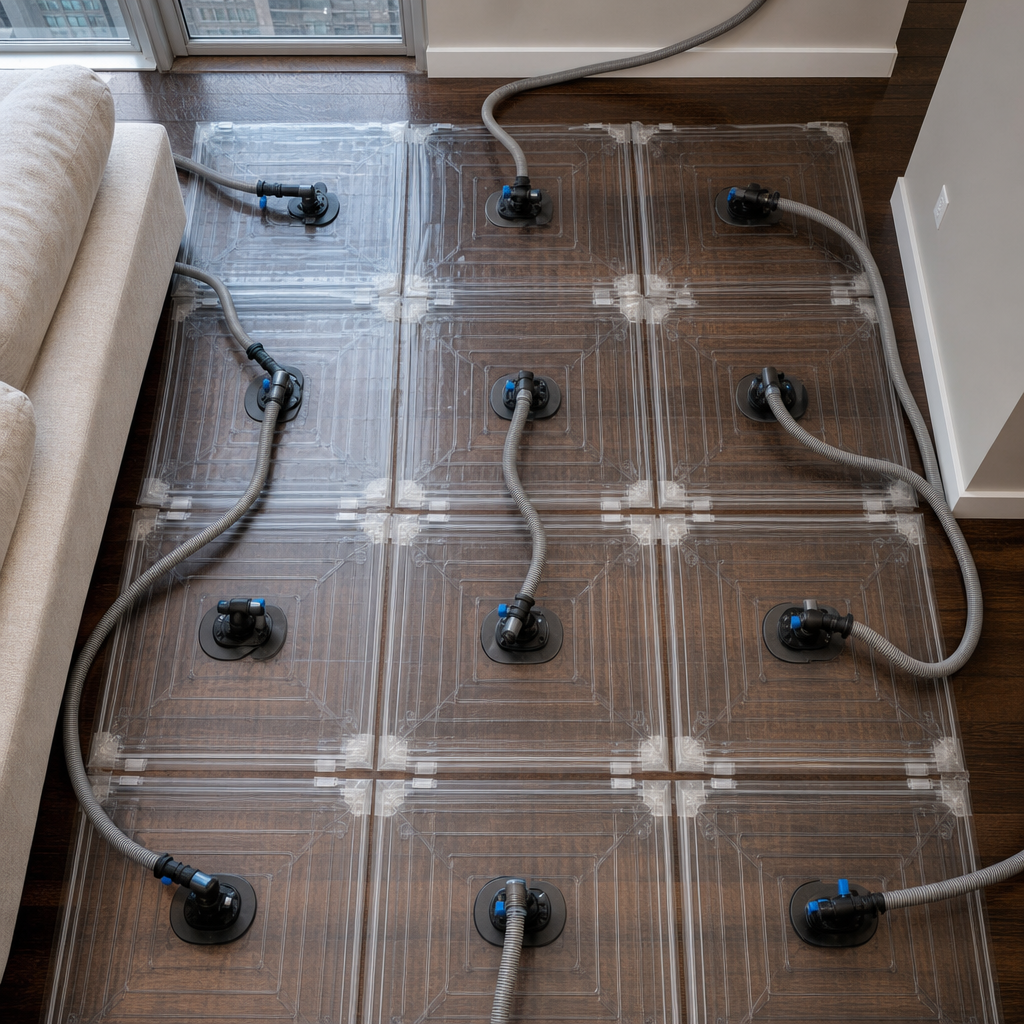
Tearing out hardwood floors creates noise complaints, dust in shared hallways, and freight elevator bottlenecks. When dealing with Category 1 water, technicians install high-pressure vacuum floor mats directly over parquet, chevron, or plank hardwoods. These systems pull trapped moisture straight out of the wood and the underlying subfloor, drawing water vapor up and out to prevent cupping and crowning.
| Project Factor | Destructive Demolition | Specialized Vacuum Mat Systems | Directed Cavity Drying |
|---|---|---|---|
| Material Preservation | Original materials discarded | Saves expensive hardwood and subfloors | Preserves plaster, drywall, and custom millwork |
| Co-op Board Approval | Often requires formal alteration review | Treated as emergency water mitigation | Treated as emergency water mitigation |
| Project Timeline | Months of reconstruction and permitting | Typically dried within 3 to 5 days | Typically dried within 3 to 5 days |
| Noise & Dust Footprint | Heavy debris, dust, and building disruption | Quiet, contained, and clean operation | Minimal disruption behind baseboards |
Targeted wall cavity drying
Instead of cutting large holes across entire walls, technicians carefully remove baseboards and make discreet, pencil-sized access points in the wall cavity. Low-profile air injection systems pump warm, dehumidified air directly into the wall void, evaporating trapped water behind kitchen cabinets, built-in vanities, and architectural plaster without destroying the room.
Preventing mold growth through professional moisture control
Mold spores require organic material, warmth, and moisture to germinate. Thorough structural drying stops microbial growth before it can establish a foothold in your building.
Detecting hidden moisture in concrete sub-slabs and vertical chases
In multi-family high-rises, water easily seeps beneath flooring and settles inside porous concrete deck slabs or hides inside shared mechanical chases. Surface areas may look dry to the naked eye while saturation remains trapped underneath. Certified technicians from Wade’s Restoration track every drop using non-invasive thermal imaging cameras, deep-probe moisture meters, and digital psychrometers, ensuring structural assemblies return to natural equilibrium moisture content.
Air scrubbing and botanical antimicrobial treatments
During active drying and water mitigation, technicians run commercial HEPA air scrubbers to capture airborne dust, particulates, and microbial spores, maintaining clean indoor air quality for building occupants. Surfaces impacted by water receive targeted applications of EPA-registered, hospital-grade antimicrobials to neutralize bacteria and inhibit secondary mold growth.
Frequently Asked Questions
How does insurance handle water damage claims?
Insurance guidance emphasizes immediate mitigation, documentation, and prompt insurer notification to support the claim process. A professional restoration team such as Wade’s Restoration provides detailed daily moisture logs, thermal images, and itemized scopes directly to your adjuster to substantiate the claim.
What documentation and licensing do Midtown West Co-op boards require?
Manhattan residential boards and managing agents require strict proof of compliance before allowing contractors into building mechanical areas. This includes a custom Certificate of Insurance (COI) listing the building corporation, managing agent, and unit owner as additional insureds with specific liability limits. Technicians must hold IICRC certifications in water damage restoration and adhere strictly to building house rules regarding service elevator hours and debris containment.
Can emergency restoration contractors handle both residential and commercial properties in Midtown West?
Yes. Experienced urban restoration teams manage everything from single-unit apartment leaks and historic townhomes to entire commercial floorplates, retail sub-basements, and multi-unit hospitality spaces. Commercial work focuses on minimizing business downtime, containing water away from shared server rooms or tenant spaces, and executing rapid drying protocols to keep your doors open.
Need water damage restoration in Midtown West?
We’re available now - call for a fast, free estimate.
Sources
- Billion-Dollar Weather and Climate Disasters | New York Summary – ncei.noaa.gov (2024)
- NYCEM Copy to Edit_Ida Damage Analysis Report [SHAREDwithJP] – nyc.gov (2021)
- Safeguarding Our Shores – Office of the New York City … – comptroller.nyc.gov (2012)
- East Side Coastal Resiliency Updated Benefit-Cost Analysis – nyc.gov
- Floodwaters clear as New York emerges from historic rainfall – washingtonpost.com
Related reading: Water Damage Restoration in Midtown Manhattan – 10% Off & Free Estimate – Same-Day Service
Related reading: Water Damage Restoration in Bayonne – 10% Off & Free Estimate – Same-Day Service
Related reading: Water Damage Restoration in Harrison | 10% Off & Free Estimate | Same-Day Service
Water Damage Restoration in Nearby Cities
We also serve the communities around Midtown West:
- Water Damage Restoration in Financial District
- Water Damage Restoration in Hoboken
- Water Damage Restoration in Long Island City
- Water Damage Restoration in Lower Manhattan
Frequently Asked Questions
What happens if a water leak in my Midtown West apartment damages the unit below?
Multi-unit leaks require immediate containment and coordinated moisture mapping across all affected vertical lines. Wade's Restoration works directly with building management, superintendents, and insurance adjusters to assess and document damage across multiple apartments while mitigating neighbor-to-neighbor structural intrusion.
How long does the non-destructive structural drying process usually take in a Midtown high-rise?
Using non-invasive methods like vacuum floor mats and cavity air injection, most structural drying projects are completed within 3 to 5 days. Wade's Restoration monitors the drying cycle with daily psychrometric logs and moisture meters to verify dry standards before equipment removal.
How quickly can Wade's Restoration provide a Certificate of Insurance (COI) for my Midtown West building management?
As an experienced Manhattan contractor, Wade's Restoration routinely generates building-compliant COIs matching specific Co-op or condo requirements in minutes. Our 24/7 dispatch team coordinates directly with front-desk security and property managers to gain immediate building access and begin emergency water extraction.
About the author
 |
Daniel Preston Daniel Preston is a certified structural drying expert with over 12 years of experience in disaster restoration across the New York metropolitan area. Holding an Environmental Science degree from Rutgers University, he specializes in rapid response strategies for water damage mitigation, mold remediation, and fire recovery. Daniel combines his technical knowledge with a practical approach to help property owners navigate the complexities of emergency restoration and insurance claims. |
Water damage, flood, or mold emergency?
We’re available now - call for a fast, free estimate.
Call Now - Free Estimate