
Quick Summary
This guide explains how commercial and residential property managers can rapidly contain vertical pipe leaks, subterranean hydrostatic pressure, and high-rise flooding through professional water damage restoration in Financial District properties. Wade's Restoration provides 24/7 live dispatch across Lower Manhattan within 45 minutes, deploying advanced cavity drying, desiccant dehumidification, and vacuum mat systems to restore structural integrity and luxury finishes without unnecessary demolition. Readers will understand the technical drying protocols and insurance documentation needed for complex claims, empowering them to contact Wade's Restoration 24/7 for rapid emergency water extraction and a free visual inspection.
Water Damage Restoration in Financial District: 24/7 Fast Help
If you need emergency water damage restoration in Financial District properties, Wade’s Restoration provides 24/7 live dispatch across Lower Manhattan within 45 minutes to stop water spread, begin immediate extraction, and protect your property. Mitigation costs depend on the scope of the damage, the water category, and specific structural drying needs. When an overhead riser fails in a high-rise or harbor water breaches a commercial sub-basement, standing water quickly threatens structural framing, high-end finishes, and indoor air quality.
Unlike national franchises that route callers through distant phone trees or immediately tear out salvageable materials, our team focuses on targeted structural drying to save luxury hardwoods, custom millwork, and complex building systems. As your single-source contractor, we manage the entire recovery from water extraction and sanitization to complete structural repairs, backed by our Claim Clarity Program for straightforward insurance documentation. Call Wade’s Restoration anytime for rapid emergency response, water extraction, and a free visual inspection. See also Water Damage Restoration in Jersey City | Call Now-10% Off | Same-Day Service | Free Estimate.
Rapid Response for High-Rises and Commercial Properties
Emergency restoration in the Financial District demands rapid containment to stop vertical leaks and manage subterranean groundwater pressure. In dense urban high-rises, uncontained water travels fast through electrical conduits, floor assemblies, and wall cavities. Arriving on-site within an hour is essential to prevent structural materials from degrading and to keep mold from taking hold.
Building materials must be stabilized within 24 to 48 hours to avoid microbial growth and permanent warping. Wade’s Restoration answers every call with live staff and dispatches technicians directly within Lower Manhattan rather than from suburban depots. Our crews use cavity drying systems, desiccant dehumidifiers, and infrared cameras to stabilize post-Sandy retrofitted basements and historic architectural finishes without unnecessary demolition. When handling high-stakes flood damage, our focus is always on stabilizing the building envelope from day one.
What Does Water Damage Restoration Cost in the Financial District?
Need water damage restoration in Financial District?
We’re available now - call for a fast, free estimate.
Water restoration costs in FiDi vary based on the water category, the affected square footage, and the depth of structural drying required. Wade’s Restoration provides free on-site visual assessments and upfront, written estimates formatted directly to insurance carrier standards.
For property managers and residential owners in Lower Manhattan, project scopes range from isolated clean-water supply line breaks to multi-floor commercial emergencies. Final costs depend on several specific variables:
Key Factors Influencing Lower Manhattan Restoration Pricing
- Subterranean Hydrostatic Pressure: FiDi basements located near the harbor often require heavy-duty submersible pumping systems to counteract groundwater pushing through foundation walls.
- Water Contamination Category: Clean water from supply lines (Category 1) requires less containment and decontamination than gray water from appliances (Category 2) or black water from sewer backups (Category 3).
- High-Rise Logistics: Moving heavy commercial air movers, desiccant units, and extractors through freight elevators and secured financial lobbies requires specialized staging and coordination.
Instead of automatically gutting wet spaces, we apply targeted drying techniques to preserve original materials whenever possible. With transparent pricing, detailed on-site evaluations, and direct claims coordination, we help eliminate surprise change orders while working hand-in-hand with your adjuster.
How Are High-Rise Commercial Floods and Sub-Basements Restored in FiDi?
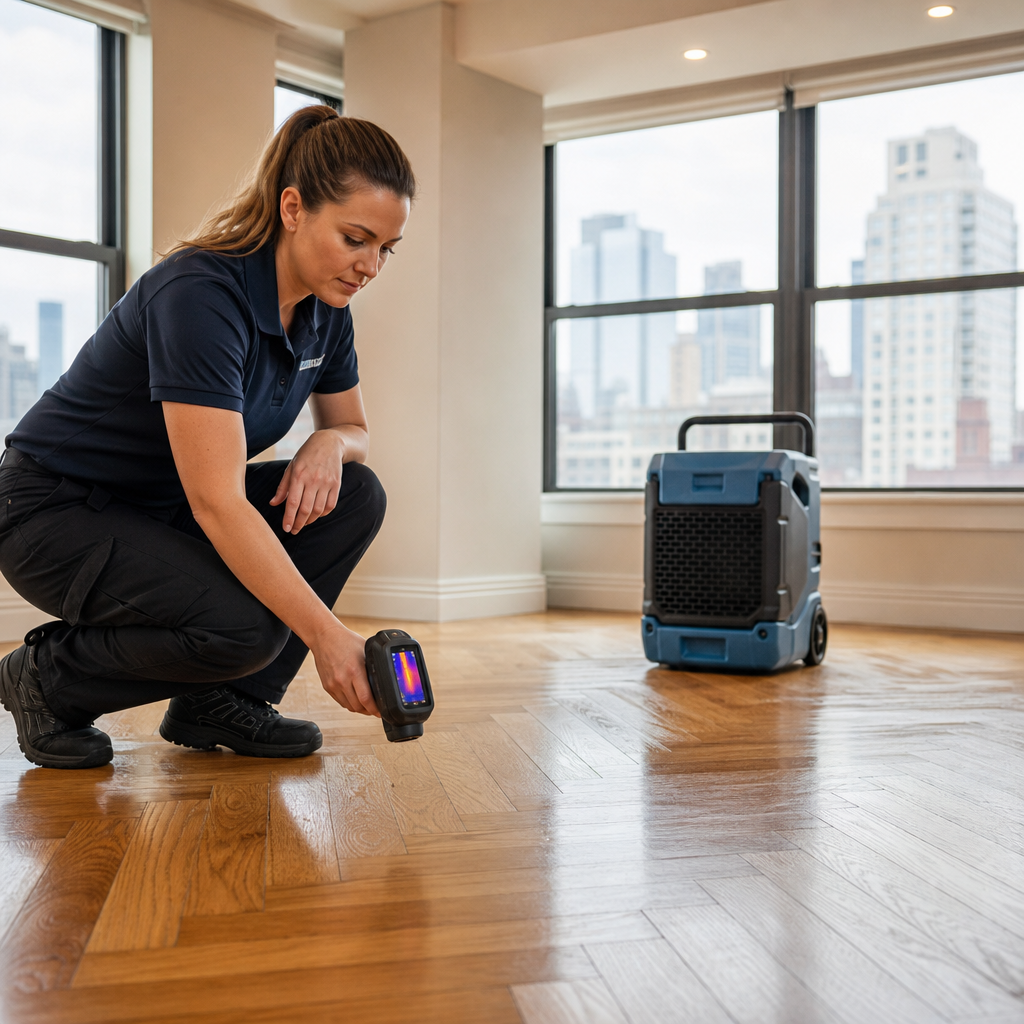
Managing water damage in Financial District high-rises and deep commercial vaults requires fast multi-floor containment, high-capacity subgrade pumping, and industrial desiccant dehumidification. Technicians isolate vertical chases, reduce hydrostatic pressure against foundation walls, and run directed structural drying to protect building infrastructure without shutting down tenant operations.
Managing Hydrostatic Dynamics in Post-Sandy Structures
Lower Manhattan rests on a high water table, leaving deep commercial basements vulnerable to severe external pressure during storm surges or main line breaks. Many commercial buildings in the district operate with flood barriers and mechanical setups modified after Hurricane Sandy. When water gets past these barriers, standing liquid creates massive hydrostatic loads against foundation walls.
We treat subgrade infrastructure with focused structural drying rather than immediate demolition. Our technicians deploy high-volume extractors to relieve structural weight right away. Rather than tearing out solid masonry or concrete assemblies, we set up industrial desiccant dehumidification to pull bound moisture from deep within the building materials, protecting electrical vaults and foundation footings.
Multi-Unit Vertical Water Migration and HVAC Protection
In commercial office towers, a broken riser or triggered fire sprinkler sends water down elevator shafts, utility chases, and electrical runs across several floors at once. Containing this spread involves three clear steps:
- Shaft Isolation: Sealing utility chases and elevator pits immediately to halt downward flow and protect hoist cables and electronics from corrosion.
- Air Handling Isolation: Shutting down linked HVAC zones so damp, contaminated air does not migrate into dry office suites.
- Cavity Injection Drying: Pumping warm, dry air straight into service chases and wall cavities to dry inner assemblies in place without cutting large access holes.
Can Hardwood Floors and High-End Finishes Be Saved Without Tear-Outs?
Need water damage restoration in Financial District?
We’re available now - call for a fast, free estimate.
Yes, hardwood flooring, historic paneling, and custom architectural finishes can often be preserved if drying starts within 24 to 48 hours. Using negative-pressure vacuum mats and controlled heat systems, our technicians draw moisture out from beneath wood planks and concrete subfloors before warping, cupping, or mold can set in.
Advanced Structural Drying vs. Demolition
Many contractors default to ripping up damp flooring because it is faster for them, but vacuum mat systems pull water directly through the face of the wood. This approach saves historic parquet, wide-plank oak, and imported materials common in FiDi lofts and luxury apartments. Drying structural materials in place also significantly lowers overall restoration costs and shortens project timelines.
| Restoration Method | Material Preservation | Subfloor Extraction | Disruption Level |
|---|---|---|---|
| Vacuum Mat Drying | High (Preserves original wood) | Direct top-down suction | Minimal (Floors remain intact) |
| Directed Heat Drying | High (Controlled moisture removal) | Vapor evaporation | Moderate (Controlled equipment footprint) |
| Demolition & Tear-Out | None (Complete material loss) | Physical removal | Severe (Weeks of loud construction) |
Preserving Subfloors, Plaster, and Custom Millwork
Historic Lower Manhattan properties and luxury condominiums often feature multi-layered subfloors and decorative plaster that cannot easily be replaced. Instead of cutting away original baseboards or custom paneling, technicians inject dry air directly into wall cavities and subfloor voids. This targeted method keeps original craftsmanship intact and avoids the long delays of custom reconstruction.
How Do You Navigate Insurance Claims for Water Damage in Lower Manhattan?
Filing a commercial or residential water claim in Lower Manhattan requires fast, clear documentation and direct communication with the carrier. Property owners need detailed moisture maps, thermal imaging scans, and itemized scopes written in standard estimating software like Xactimate before work begins. This establishes clear proof of loss and helps avoid claim disputes.
The Importance of Thermal Imaging and Daily Moisture Logs
Insurance claims often stall when contractors fail to prove how far moisture traveled inside concrete slabs or behind fire-rated drywall. Securing prompt carrier approval depends on organized data:
- Thermal Mapping: Infrared cameras document hidden moisture paths behind finished surfaces without invasive drywall cuts.
- Psychrometric Tracking: Daily logs record relative humidity, temperature, and grains per pound (GPP) to prove active drying progress.
- Standardized Line Items: Estimates built using standard insurance pricing databases support every phase of mitigation and repair.
Direct Adjuster Coordination
Through our Claim Clarity Program, Wade’s Restoration communicates directly with your adjuster from the initial inspection to final sign-off. Having a single team handle both mitigation and structural rebuild prevents the finger-pointing that happens when multiple contractors are involved. Contact Wade’s Restoration 24/7 for fast dispatch and help navigating your claim.
Frequently Asked Questions About Water Damage Restoration in the Financial District
How quickly can crews arrive, and what steps should managers take first?
Our technicians arrive on-site within 45 to 60 minutes across Lower Manhattan. While waiting for the crew to arrive, building staff should take these immediate steps:
- Shut down the local riser valve or the main water shut-off for the floor.
- Turn off electrical breakers serving any wet areas.
- Call elevator cabs to upper floors to keep mechanical pits dry.
- Contact Wade’s Restoration for immediate dispatch and extraction support.
How is mold prevented in an office high-rise after a major pipe burst?
Mold can begin colonizing within 24 to 48 hours on damp drywall, carpet backing, and acoustic ceiling tiles. Technicians prevent growth by setting up commercial desiccant dehumidifiers to lower relative humidity below 50 percent, combined with negative-pressure cavity drying to pull hidden moisture from wall assemblies.
Does commercial property insurance cover burst pipes and water damage?
Most standard commercial property policies cover sudden and accidental water discharges, such as frozen supply lines, burst fire sprinkler pipes, or failed mechanical risers. Coverage for rising floodwaters or storm surges generally requires a separate policy through the National Flood Insurance Program (NFIP) or a private commercial flood policy. Detailed moisture mapping and Xactimate-formatted documentation are critical for smooth claim approval.
Can business operations continue while water extraction is underway?
In many cases, yes. By setting up physical containment barriers, using negative air machines with HEPA filtration, and running low-profile drying equipment, we can isolate the affected zones so your staff and tenants can continue working safely in adjacent areas.
Need water damage restoration in Financial District?
We’re available now - call for a fast, free estimate.
Related reading: Water Damage Restoration in Bayonne – 10% Off & Free Estimate – Same-Day Service
Frequently Asked Questions
How does Wade's Restoration handle water intrusion in commercial elevator shafts and mechanical vaults?
Technicians isolate the affected vertical chases, pump standing water from elevator pits using high-volume extractors, and deploy industrial desiccant dehumidifiers to dry hoist cables and electrical runs. This targeted stabilization prevents severe corrosion and helps building managers avoid costly elevator cab and mechanical replacements.
How is subterranean groundwater pressure managed in Lower Manhattan basements near the harbor?
To counter the Financial District's high water table, Wade's Restoration deploys high-capacity submersible pumps to relieve hydrostatic pressure against foundation walls. Crews then apply deep desiccant structural drying to pull bound moisture out of thick masonry and concrete footings without structural demolition.
What documentation does Wade's Restoration provide through the Claim Clarity Program?
The Claim Clarity Program compiles infrared thermal maps, daily psychrometric drying logs, and line-item estimates generated directly in Xactimate. Wade's Restoration coordinates directly with insurance adjusters from initial water extraction through final structural repairs to eliminate coverage disputes and speed up claim approval.
About the author
 |
Daniel Preston Daniel Preston is a certified structural drying expert with over 12 years of experience in disaster restoration across the New York metropolitan area. Holding an Environmental Science degree from Rutgers University, he specializes in rapid response strategies for water damage mitigation, mold remediation, and fire recovery. Daniel combines his technical knowledge with a practical approach to help property owners navigate the complexities of emergency restoration and insurance claims. |
Water damage, flood, or mold emergency?
We’re available now - call for a fast, free estimate.
Call Now - Free Estimate