
Quick Summary
Addressing sudden plumbing leaks, sewer backups, and storm flooding across local flood zones requires prompt professional water damage restoration in Williamsburg to prevent irreversible structural decay and mold colonization within 24 to 48 hours. Wade's Restoration provides rapid emergency mitigation using live dispatch, specialized hardwood and subfloor drying systems, and industrial dehumidification tailored to preserve both historic and modern urban building materials. Property owners will understand essential emergency response and insurance claim protocols and can immediately contact Wade's Restoration 24/7 for rapid extraction dispatch or to schedule a free visual inspection and moisture assessment.
Water Damage Restoration in Williamsburg: Fast Emergency Help
When water enters an apartment or building in Williamsburg, prompt mitigation is essential. Standing water can seep past finished flooring and penetrate subfloors, framing, and masonry. Professional water damage restoration focuses on stopping active leaks, extracting standing water, and drying structural materials before permanent damage or mold takes hold.
According to the New York City Department of City Planning, more than 15% of NYC land is currently in the 1% annual chance floodplain, where more than 400,000 residents live, and Brooklyn has more than 300,000 residents within the 1% and 0.2% annual chance floodplains. Flood-hazard mapping identifies areas subject to coastal and overland flooding, which are distinct from non-flood causes of water damage such as interior plumbing leaks and sewer backups. CDC and EPA guidance in the research brief recommends cleaning and drying water-damaged areas within 24 to 48 hours if possible to help prevent mold growth.[1]
Quick answer: What should you do during a water emergency in Williamsburg?
Immediate steps: Shut off the main water valve immediately, turn off electricity to affected rooms if the breaker panel is safe to access, and contact an emergency restoration specialist. Document damage with photos and video, notify your insurer promptly, preserve damaged items when practical, and save receipts for emergency expenses. Avoid walking through deep standing water or handling electrical items while wet.
Immediate emergency protocol
- Isolate hazards: Turn off the primary water shutoff valve. If you can reach your breaker box without stepping in water, cut power to the flooded areas.
- Protect your belongings: Move rugs, electronics, and valuable furniture out of wet areas, or place aluminum foil or wood blocks under furniture legs to prevent stain transfer.
- Call a restoration provider: Contact a mitigation team to extract standing water and evaluate structural moisture levels.
- Document and notify: Record detailed photos and videos of the source, water levels, and damaged property, notify your insurer promptly, preserve damaged items when practical, and save all receipts for emergency expenses.
Target response window
CDC and EPA guidance in the research brief recommends cleaning and drying water-damaged areas within 24 to 48 hours if possible to help prevent mold growth. Prompt extraction and dehumidification help remove moisture before mold spores colonize building materials and enclosed cavities.[2]
What does water damage restoration cost in Williamsburg?
Need water damage restoration in Williamsburg?
We’re available now - call for a fast, free estimate.
According to Wade’s Restoration, restoration costs in Williamsburg depend on the water source, duration of exposure, and square footage involved. A clean water leak addressed quickly requires less labor and equipment than a multi-floor sewage backup or flood loss. Pricing is determined based on required extraction, drying equipment runtime, sanitization, and material repair or removal.
Restoration pricing breakdown
Restoration work generally addresses three contamination categories based on the water source:
| Feature | Clean Water (Category 1) | Grey Water (Category 2) | Black Water (Category 3) |
|---|---|---|---|
| Common Sources | Supply line bursts, sink overflows, clean rainwater | Washing machine discharge, dishwasher leaks, sump pump failures | Sewage backups, street flooding, surface floodwaters |
| Structural Impact | Flooring and walls can often be dried in place when addressed promptly | Porous materials such as carpet padding and insulation may require removal | Contaminated porous materials typically require safe removal and disposal |
| Equipment Used | Dehumidifiers, high-velocity air movers, specialty floor drying panels | Dehumidifiers, air movers, cavity drying equipment, air filtration devices | HEPA air filtration, containment barriers, commercial extraction units |
| Sanitization Level | Standard cleaning and surface treatment as needed | Cleaning and application of appropriate sanitizing agents | Containment, thorough biohazard cleaning, and sanitization |
Navigating insurance claims and coverage
Insurance coverage depends on the cause of damage and the specific policy. Standard homeowners and commercial property policies generally cover sudden and accidental internal water damage, such as a burst supply pipe, but typically exclude flood damage. Water-backup or sewage damage may require an optional endorsement, and separate National Flood Insurance Program (NFIP) or private flood coverage may apply to qualifying flood losses.
Flood-hazard mapping is distinct from interior plumbing leaks, sewer backups, and other non-flood causes of water damage. FEMA identifies its Flood Map Service Center and the National Flood Hazard Layer as official public sources for flood-hazard maps. NYC Open Data identifies records in South Williamsburg and East Williamsburg with differing hazard classifications, rather than a uniform risk across each neighborhood. To support an insurance claim, homeowners should document damage thoroughly, notify their insurer promptly, preserve damaged items when practical, and save receipts for all emergency mitigation expenses.[4]
How are hardwood floors and subfloors dried and restored?
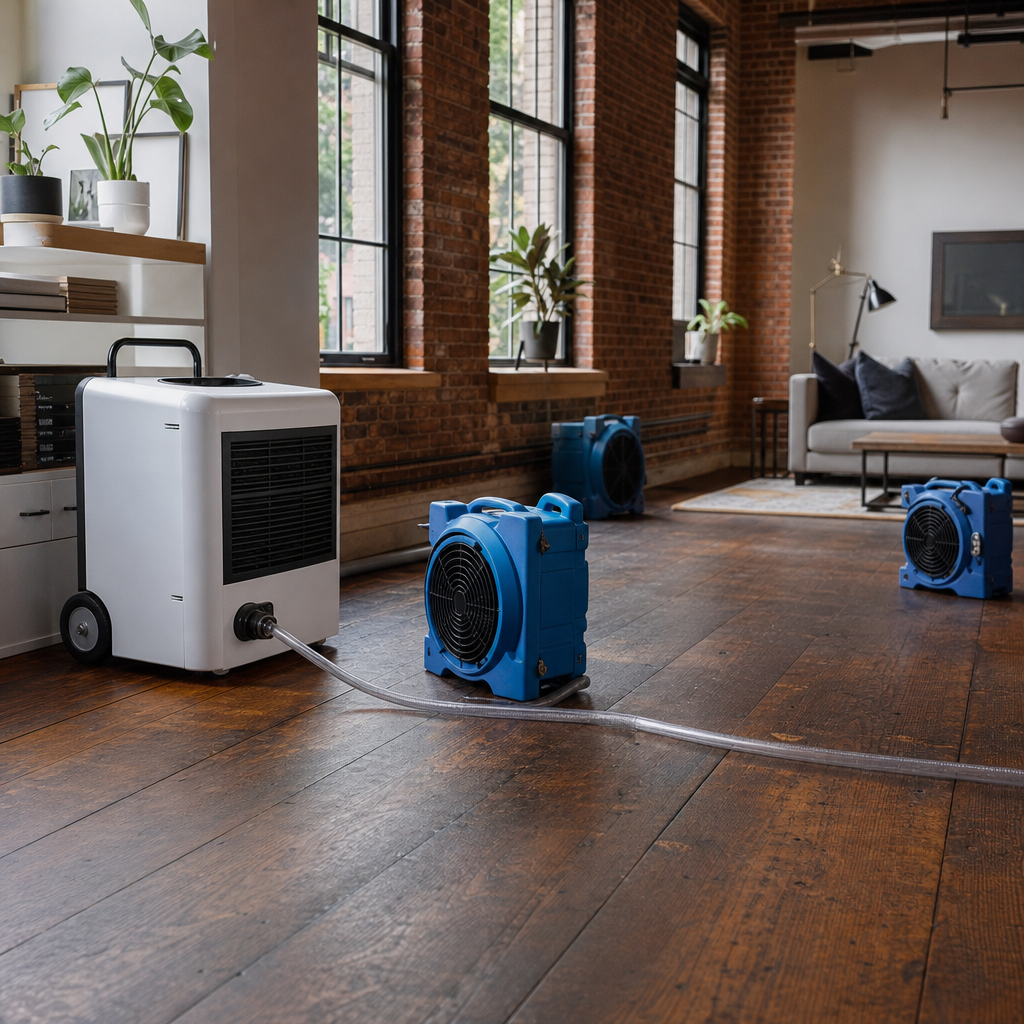
When water affects wood flooring and subfloor assemblies, restoration approaches depend on the water category and extent of saturation. When clean water is addressed early, specialized drying systems can often extract trapped moisture without requiring immediate material removal.
Technicians may use specialty floor drying mats connected to extraction units to draw moisture from floorboards and underlying subfloors. Controlled air movement and dehumidification help remove water vapor from structural assemblies while moisture levels are monitored.
Structural drying and material evaluation
Framing and subflooring affected by clean water can often be dried in place if addressed before structural deterioration occurs. When water has been contaminated or materials have suffered prolonged saturation, compromised porous components may need removal to ensure thorough drying and sanitation.
Symptoms of subfloor saturation
Moisture can remain trapped beneath surface flooring. Restoration specialists at Wade’s Restoration check for specific warning signs during moisture assessments:
- Cupping and crowning: Planks with raised edges or bulging centers indicate a moisture imbalance across the wood.
- Subfloor deflection: A soft or spongy feel underfoot indicates that underlying subflooring has absorbed substantial moisture.
- Moisture migration: Water traveling along sill plates, masonry, or joist assemblies into adjacent structural framing.
How do restoration specialists address moisture and prevent mold growth?
Need water damage restoration in Williamsburg?
We’re available now - call for a fast, free estimate.
Because below-grade and ground-level spaces are vulnerable to elevated humidity and moisture retention, prompt mitigation is necessary. CDC and EPA guidance in the research brief recommends cleaning and drying water-damaged areas within 24 to 48 hours if possible to help prevent mold growth.[5]
Williamsburg floodplain risks and moisture assessment
NYC Open Data identifies records in South Williamsburg and East Williamsburg with differing hazard classifications, rather than implying a uniform risk across each neighborhood. FEMA flood maps designate specific coastal and surface flood hazard areas, which are distinct from interior plumbing failures or sewer backups. As noted by Wade’s Restoration, when water intrudes into a building, thorough physical extraction must precede structural dehumidification to return indoor humidity to balanced levels.[3]
Sanitization and dehumidification procedures
Professional water mitigation follows structured drying and cleaning practices:
- Containment and air filtration: Technicians may install isolation barriers and air filtration units to prevent dust and airborne particulates from spreading into unaffected areas.
- Cleaning and sanitization: Appropriate sanitizing agents are applied to affected structural surfaces based on the contamination category of the water source.
- Controlled dehumidification: Industrial dehumidifiers and air movers are deployed to create airflow and extract moisture from structural elements, with progress tracked through ongoing moisture assessments.
Frequently asked questions about water damage restoration in Williamsburg
Common local mitigation questions
How fast can an emergency water damage team arrive in Williamsburg?
Arrival times vary by provider availability, traffic, building access, and incident severity. Confirm the expected arrival time when calling.
How much does professional water damage restoration cost in Williamsburg?
Costs depend on the water contamination category (clean, grey, or black), the square footage affected, and whether materials can be dried in place or require removal. Pricing is generally itemized based on on-site inspection and moisture mapping.
Does homeowners insurance cover emergency water extraction and flood repair?
Coverage depends on the cause of damage and the policy. Standard homeowners policies typically cover sudden and accidental internal water damage, but exclude flood damage. Water-backup or sewage damage may require an endorsement, and separate NFIP or private flood coverage may apply to qualifying flood losses.
What should I do immediately while waiting for water mitigation specialists?
Shut off the main water line, stay away from standing water near electrical hazards, document damage with photos and video, notify your insurer promptly, preserve damaged items when practical, and save receipts for emergency expenses.
How long does the water drying and restoration process take?
Drying time varies with the extent and type of damage and should be confirmed through ongoing assessment.
How do restoration contractors prevent mold growth after water damage?
CDC and EPA guidance in the research brief recommends cleaning and drying water-damaged areas within 24 to 48 hours if possible to help prevent mold growth. Restoration specialists, such as the team at Wade’s Restoration, use rapid water extraction, controlled airflow, and industrial dehumidifiers to dry affected materials within this window.
Need water damage restoration in Williamsburg?
We’re available now - call for a fast, free estimate.
Sources
- nyc_comprehensive_waterfront_plan_climate_resiliency_and_adaptation.pdf – nyc.gov (2050)
- [PDF] Urban Climate – NASA Technical Reports Server (NTRS) – ntrs.nasa.gov (2015)
- FEMA FLOOD RISK – fema.gov (2018)
- FEMA Flood Map Service Center: Search By Address – msc.fema.gov
- A machine learning approach to evaluate the spatial … – repository.library.noaa.gov
Water Damage Restoration in Nearby Cities
We also serve the communities around Williamsburg:
- Water Damage Restoration in Jersey City
- Water Damage Restoration in Bayonne
- Water Damage Restoration in Financial District
- Water Damage Restoration in Harrison
- Water Damage Restoration in Hoboken
- Water Damage Restoration in Kearny
- Water Damage Restoration in Long Island City
- Water Damage Restoration in Lower Manhattan
Frequently Asked Questions
Can hardwood floors in historic Williamsburg buildings be saved after water damage without full replacement?
Yes, when addressed early, specialized negative-pressure floor drying systems can extract trapped moisture directly from floorboards and underlying subfloors. Wade's Restoration utilizes preservation-focused drying methods tailored for urban properties to stabilize wood assemblies and prevent permanent cupping without unnecessary tear-outs.
What happens during a professional moisture assessment in a Williamsburg property?
Restoration technicians evaluate structural elements to locate hidden moisture traveling behind masonry, joists, and subflooring using calibrated moisture meters. Wade's Restoration provides free visual inspections and moisture assessments to map hidden saturation and determine the exact dehumidification setup required.
How is black water or sewage backup mitigation handled differently from clean pipe leaks?
Category 3 black water requires immediate physical containment barriers, HEPA air filtration, biohazard sanitization, and the disposal of unsalvageable porous items to eliminate pathogens. Property owners facing sewage or overland flooding can call Wade's Restoration 24/7 for rapid live dispatch and certified sanitization.
About the author
 |
Daniel Preston Daniel Preston is a certified structural drying expert with over 12 years of experience in disaster restoration across the New York metropolitan area. Holding an Environmental Science degree from Rutgers University, he specializes in rapid response strategies for water damage mitigation, mold remediation, and fire recovery. Daniel combines his technical knowledge with a practical approach to help property owners navigate the complexities of emergency restoration and insurance claims. |
Water damage, flood, or mold emergency?
We’re available now - call for a fast, free estimate.
Call Now - Free Estimate