
Quick Summary
Severe coastal storm surges and plumbing failures make rapid emergency water damage restoration in Lower Manhattan critical for safeguarding vulnerable subgrade mechanical systems and dense high-rise structures from catastrophic moisture intrusion. As a dedicated rapid-response specialist, Wade's Restoration deploys advanced thermal moisture mapping, negative-pressure cavity drying, and heavy-duty extraction equipment to stabilize complex downtown properties quickly. Property owners can secure 24/7 live dispatch and a free on-site water damage assessment from Wade's Restoration to ensure immediate structural containment, mold mitigation, and efficient insurance documentation.
Emergency Water Damage Restoration in Lower Manhattan
A burst pipe or storm surge in a downtown building requires immediate action to mitigate moisture penetration into subflooring, plaster, and structural framing. Restoration providers state that their emergency crews deploy to residential and commercial properties to extract standing water, stabilize indoor moisture, and halt structural degradation.[1]
According to the NYC Mayor’s Office of Climate and Environmental Justice, Hurricane Sandy flooded 17% of New York City’s land area and caused $19 billion in losses. In response to environmental risks, restoration providers like Wade’s Restoration report focusing on rapid stabilization, moisture mapping, and in-place drying techniques.[5] See also Water Damage Restoration in Jersey City | Call Now-10% Off | Same-Day Service | Free Estimate.
Immediate Safety Steps
If safe, shut off electricity and water. Avoid wet electrical equipment and contaminated floodwater. Leave immediately if structural, gas, or electrical hazards exist. Ventilate the space when safe, wear waterproof boots and gloves, document damage, and do not re-enter until authorities or qualified professionals say it is safe.
What to Expect During Emergency Water Damage Restoration
Restoration providers describe standard emergency response procedures as prioritizing containment, moisture extraction, and stabilization:
- On-Site Assessment: Providers state that technicians assess water contamination levels and establish containment zones to protect unaffected areas.
- Moisture Mapping: Technicians report using moisture meters and thermal imaging to track moisture paths through building materials.
- Water Extraction: Crews utilize submersible pumps and extraction equipment to remove standing water.
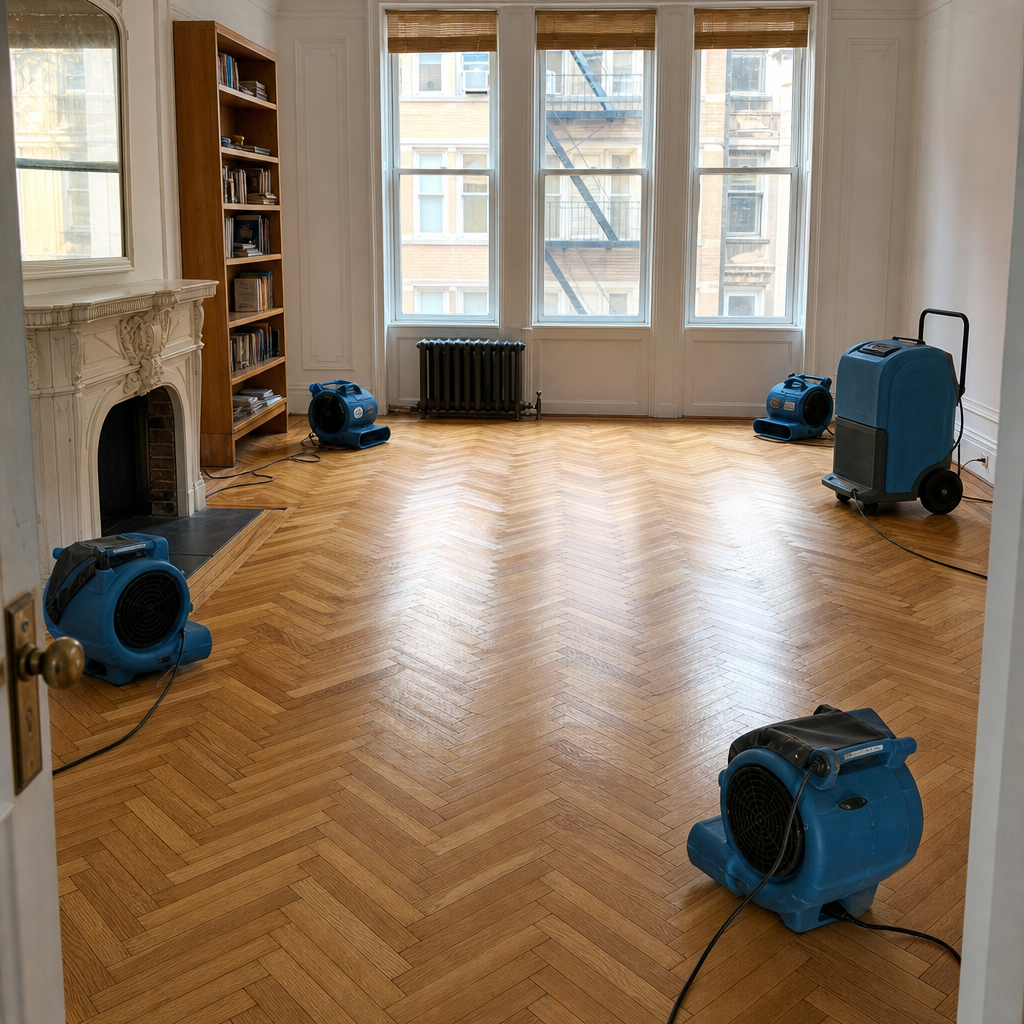
- Structural Drying: Providers report deploying dehumidification equipment and air movers to dry framing and structural assemblies.
- Insurance Documentation: Technicians record moisture readings, logs, and itemized inventories to assist property owners with claim filing.
What Does Emergency Water Damage Restoration Cost in Lower Manhattan?
Need emergency water damage restoration in Lower Manhattan?
We’re available now - call for a fast, free estimate.
No reliable neutral cost range can be stated from the supplied evidence. Costs depend on water category, affected area, extraction and drying requirements, demolition, contents, and rebuilding.
Navigating Property Insurance Claims
Sudden water damage from a burst pipe may be covered subject to policy terms, exclusions, deductibles, and maintenance-related limitations. Storm flooding is generally excluded from standard policies and usually requires separate flood insurance, while water-backup coverage may apply in some cases.[3]
Lower Manhattan Environmental Exposure and In-Place Drying
According to the NYC Mayor’s Office of Climate and Environmental Justice, projections indicate approximately 2.5 feet of sea-level rise by the 2050s and more than 6 feet by 2100, with parts of downtown facing recurring flooding by the 2040s and monthly flooding by the 2050s. New York City’s Flood Hazard Mapper provides current and future coastal-flood-hazard information based on climate-change scenarios.[2]
To address water intrusion, restoration providers such as Wade’s Restoration report utilizing in-place drying protocols, which they state include:
- Negative-Pressure Floor Systems: Vacuum mat systems stated by providers to pull trapped moisture from flooring assemblies.
- Cavity Drying Systems: Air injection into wall cavities intended to dry internal framing.
- Desiccant Dehumidification: Industrial dehumidifiers deployed to extract moisture from dense masonry and structural timbers.
Managing Water Contamination in Subgrade Structures
When contaminated water enters lower levels and mechanical spaces, restoration providers like Wade’s Restoration state that they implement containment and remediation procedures:[4]
- Isolation Barriers: Polyethylene sheeting and air filtration systems placed to isolate affected zones.
- High-Capacity Extraction: Submersible pumps used to remove standing water and waste.
- Cleaning and Disinfection: Application of antimicrobial solutions to clean and treat affected non-porous surfaces.
Frequently Asked Questions
How quickly can an emergency restoration crew arrive in Lower Manhattan?
Response time varies by provider, location, traffic, building access, weather, and call volume. Confirm the estimated arrival directly with the restoration provider.
How long does the structural drying process take?
Drying timelines vary depending on the extent of water intrusion, the types of structural materials affected, and environmental conditions. Restoration providers such as Wade’s Restoration monitor drying progress using moisture-detection instruments.
How do technicians address mold growth after water damage?
Restoration providers report managing mold risks by removing standing water, setting up air movement and dehumidification equipment to reduce moisture, and applying antimicrobial treatments to affected materials.
What immediate steps should I take while waiting for the restoration team?
If safe, shut off electricity and water, avoid wet electrical equipment and contaminated floodwater, leave if hazards exist, ventilate when safe, wear waterproof boots and gloves, document damage, and do not re-enter until authorities or qualified professionals confirm it is safe.
Need emergency water damage restoration in Lower Manhattan?
We’re available now - call for a fast, free estimate.
Sources
- Lower Manhattan Climate Resilience Study – nyc.gov (2050)
- Enhancing Adaptation to Sea Level Rise and Coastal Flooding … – academiccommons.columbia.edu (2024)
- LOWER MANHATTAN COASTAL RESILIENCY – nyc.gov (2021)
- Mayor de Blasio Announces Resiliency Plan to Protect Lower Manhattan From Climate Change – nyc.gov (2021)
- PowerPoint Presentation – nyc.gov (2019)
Related reading: Emergency Water Damage Restoration in Long Island City – Call Now-10% Off – On-Site in 60 Minutes – Free Estimate
Related reading: Water Damage Restoration in Bayonne – 10% Off & Free Estimate – Same-Day Service
Related reading: Water Damage Restoration in West New York – Call Now-10% Off – Same-Day Service – Free Estimate
Emergency Water Damage Restoration in Nearby Cities
We also serve the communities around Lower Manhattan:
- Emergency Water Damage Restoration in Jersey City
- Emergency Water Damage Restoration in Bayonne
- Emergency Water Damage Restoration in Financial District
- Emergency Water Damage Restoration in Harrison
- Emergency Water Damage Restoration in Hoboken
- Emergency Water Damage Restoration in Kearny
Frequently Asked Questions
How does emergency restoration handle water intrusion in Lower Manhattan high-rises and sub-grade basements?
Wade's Restoration utilizes high-capacity submersible extraction, negative-pressure floor drying, and industrial desiccant dehumidification specifically designed for dense masonry and sub-grade mechanical vaults. Crews establish sealed isolation barriers to protect critical building infrastructure while rapidly extracting contaminated floodwater or pipe burst runoff.
How does Wade's Restoration help property owners with insurance claims after water damage?
During your free on-site assessment and active mitigation, Wade's Restoration captures thermal imaging moisture maps, daily atmospheric drying logs, and itemized structural inventories. This detailed documentation provides insurers with verifiable evidence required to process complex residential and commercial water damage claims smoothly.
How quickly can I secure emergency water extraction and drying in Lower Manhattan?
Property owners can access 24/7 live dispatch by calling Wade's Restoration immediately after an intrusion occurs. Rapid emergency deployment ensures early containment, preventing extensive structural degradation and mitigating mold proliferation in dense downtown buildings.
About the author
 |
Daniel Preston Daniel Preston is a certified structural drying expert with over 12 years of experience in disaster restoration across the New York metropolitan area. Holding an Environmental Science degree from Rutgers University, he specializes in rapid response strategies for water damage mitigation, mold remediation, and fire recovery. Daniel combines his technical knowledge with a practical approach to help property owners navigate the complexities of emergency restoration and insurance claims. |
Water damage, flood, or mold emergency?
We’re available now - call for a fast, free estimate.
Call Now - Free Estimate