
Quick Summary
When pipe bursts or flash floods threaten residential and commercial properties, professional emergency water damage restoration in Long Island City is essential to halt rapid moisture migration and structural decay. Wade's Restoration provides 24/7 rapid response, deploying commercial extraction equipment, thermal moisture mapping, and targeted structural drying to salvage framing, flooring, and critical mechanical rooms. Property owners can rely on Wade's Restoration for immediate on-site stabilization, transparent project estimates, and comprehensive documentation to navigate insurance claims efficiently.
Emergency Water Damage Restoration in Long Island City
When a pipe bursts on an upper floor or water penetrates a sub-basement, Long Island City properties face immediate structural threats. Water can spread along utility lines, shared wall cavities, and structural framing. Emergency water damage restoration services, such as those provided by Wade’s Restoration, assist property owners with water extraction, structural drying, and property recovery.[5]
Quick Summary: Emergency water damage restoration involves stopping the water source, extracting standing liquid, applying dehumidification, and treating building materials to prevent mold. In Long Island City, rapid mitigation protects properties – which may range from modern multi-unit buildings to older converted industrial spaces – from secondary moisture damage and decay.[2] See also Water Damage Restoration in Jersey City | Call Now-10% Off | Same-Day Service | Free Estimate.
Long Island City is located within Queens Community District 1, where 1,961 buildings, or 8 percent of district buildings, were in the FEMA floodplain in 2019. Approximately 80 percent of those floodplain buildings predated 1961, and roughly 60 percent had full below-grade basements. While available research supports flood exposure and rainfall hazards in this area, it does not establish a standalone market-size or incident-count statistic for emergency restoration in Long Island City.[1]
How Quickly Can Restoration Crews Arrive in Long Island City?
Response time varies based on crew availability, traffic, building access, and incident severity, so confirm the estimated arrival time directly before dispatch.
Halting Vertical Water Migration in Different Building Types
Water migration patterns depend on individual site conditions and architectural features:
| Possible Building Condition | Primary Migration Pathway | Mitigation & Drying Strategy |
|---|---|---|
| Multi-Unit Structures | Vertical pipe chases, electrical risers, elevator shafts, subflooring | Source isolation, downward chase containment, and water extraction |
| Timber and Masonry Structures | Exposed timber framing, plank subfloors, masonry party walls | Controlled structural drying, thermal imaging assessment, and dehumidification |
In multi-family structures, water may move downward through ceiling plenums and conduit lines into lower units. In older timber and masonry structures, moisture can penetrate deep into wood framing and unsealed brickwork. Technicians at Wade’s Restoration typically use thermal imaging cameras and non-invasive moisture meters to track moisture paths behind drywall and under floor assemblies.[4]
Steps in the Emergency Water Mitigation Process
A structured approach helps ensure hidden moisture is identified and addressed:
- Emergency Inspection and Safety Evaluation: Technicians evaluate building safety, check for electrical hazards, and map the boundary of moisture intrusion.
- Bulk Water Extraction: Submersible pumps and vacuum units remove standing water from floors, sub-grade spaces, and basements.
- Targeted Structural Drying: Dehumidifiers and air movers draw trapped moisture out of wall cavities, subfloors, and framing lumber.
- Antimicrobial Application: Technicians treat affected structural components with EPA-registered sanitizing solutions to inhibit microbial growth.
- Moisture Monitoring: Daily readings track drying progress until materials reach stable baseline levels.
Which Structural Components Can Be Saved vs. Replaced?
Need emergency water damage restoration in Long Island City?
We’re available now - call for a fast, free estimate.
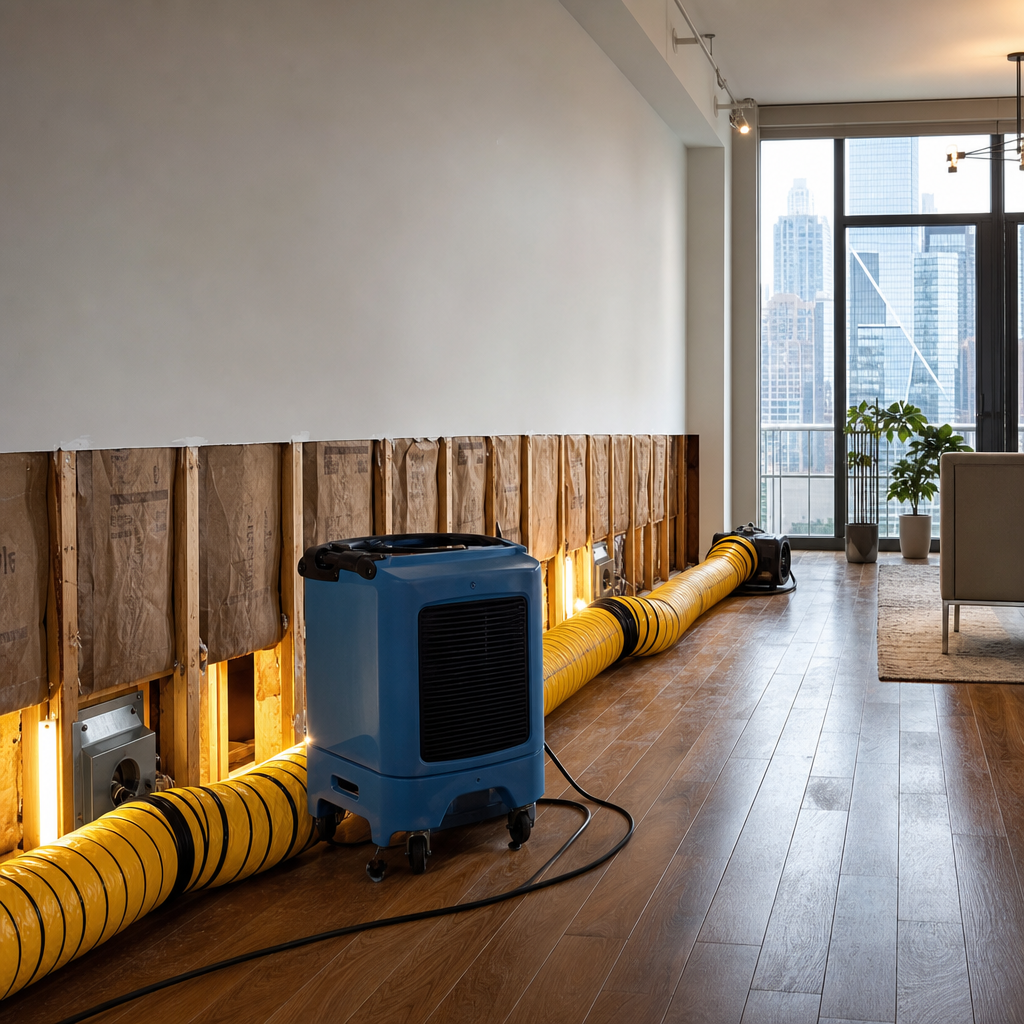
Whether materials can be restored depends on water category, contamination levels, and exposure duration.
| Structural Material | Restoration Protocol and Considerations |
|---|---|
| Solid Hardwood Flooring | Specialized drying mats and targeted vacuum extraction may be used if wood is intact. |
| Heavy Timber Joists | Airflow, desiccant drying, and surface sanitization are applied to stabilize structural wood. |
| Drywall and Plaster | Materials affected by clean water may be dried in place, whereas contaminated or structurally compromised drywall must be removed. |
| Fiberglass/Cellulose Insulation | Saturated insulation is generally removed and disposed of to eliminate hidden moisture traps. |
Protecting Sub-Basements and Mechanical Equipment
Intense rainfall can contribute to flooding, and Queens faces substantial flood exposure, including outside the traditional FEMA 100-year floodplain. When sub-grade commercial spaces flood, mechanical equipment, boilers, switchgear, and elevator pits face potential corrosion and damage. Mitigation teams, including specialists from Wade’s Restoration, prioritize removing standing water and dehumidifying mechanical rooms to stabilize electrical components and reduce operational downtime.[3]
What Does Emergency Water Damage Restoration Cost in Long Island City?
No authoritative Queens-specific price range is established in the brief. Property owners should obtain a written, itemized estimate before work begins. Restoration costs depend on factors such as the water source, affected square footage, and the extent of mitigation required.
Key factors influencing an estimate include:
- Water Category: Category 1 (clean supply line), Category 2 (gray water from appliances), or Category 3 (black water from sewage or flood run-off). Higher contamination levels require specialized safety measures and disposal steps.
- Required Equipment: The number and types of air movers, dehumidifiers, and HEPA air scrubbers placed on site.
- Controlled Demolition: Whether baseboards, drywall flood cuts, or saturated floor coverings need removal.
- Rebuild Scope: Reinstalling insulation, drywall, trim, and flooring once structural drying is complete.
Navigating Insurance Claims and Documentation
Insurance coverage is policy-dependent. Standard property insurance policies typically distinguish between sudden, accidental internal water damage (such as a burst pipe), overland flood damage, and sewer or sump-pump backups. Flood damage generally requires a separate policy through the NFIP or a private flood carrier, while sewer or drain backups often require a specific policy endorsement. Restoration providers like Wade’s Restoration typically document the mitigation process with photos, drying logs, and moisture readings to assist policyholders during the claims review.
Frequently Asked Questions
What should I do immediately after discovering water damage?
Avoid floodwater and wet electrical equipment, stop the water source if possible, and turn off electricity only if it is safe to do so. Contact an emergency restoration service and notify your insurance carrier as soon as possible.
How do professionals prevent mold growth after water intrusion?
Professionals prevent microbial growth by rapidly extracting standing water, lowering indoor humidity levels with commercial dehumidifiers, maintaining continuous airflow across damp surfaces, and applying EPA-registered antimicrobial solutions to exposed structural components.
Does insurance cover emergency water damage and cleanup in Queens, NY?
Coverage depends entirely on your specific policy. Most standard property policies cover sudden and accidental internal water events, but overland flooding and sewer or sump-pump backups generally require dedicated riders or separate flood insurance policies. Check your policy terms directly with your insurer.
How long does the structural drying process take?
Drying duration varies depending on the volume of water, affected building materials, temperature, and relative humidity. Technicians from Wade’s Restoration monitor structural components daily using moisture meters until materials return to acceptable baseline levels.
Need emergency water damage restoration in Long Island City?
We’re available now - call for a fast, free estimate.
Sources
- [PDF] 1 CITY COUNCIL CITY OF NEW YORK – legistar.council.nyc.gov (2025)
- Community Board Meeting: CB 1 Queens – Presentation September 4, 2019 – nyc.gov (2019)
- CHAPTER 2 PROFILE OF NEW YORK CITY BUILDINGS IN THE FLOODPLAN – nyc.gov (2013)
- Flood Resilience Zoning Text Update – nyc.gov (2015)
- Flood Risk and the Tristate Housing Market – newyorkfed.org
Related reading: Emergency Water Damage Restoration in Kearny | Call Now-10% Off | On-Site in 60 Minutes | Free Estimate
Related reading: Water Damage Restoration in Bayonne – 10% Off & Free Estimate – Same-Day Service
Related reading: Water Damage Restoration in West New York – Call Now-10% Off – Same-Day Service – Free Estimate
Emergency Water Damage Restoration in Nearby Cities
We also serve the communities around Long Island City:
- Emergency Water Damage Restoration in Jersey City
- Emergency Water Damage Restoration in Bayonne
- Emergency Water Damage Restoration in Financial District
- Emergency Water Damage Restoration in Harrison
- Emergency Water Damage Restoration in Hoboken
Frequently Asked Questions
How does Wade's Restoration detect hidden moisture inside walls and floors in Long Island City buildings?
Wade's Restoration utilizes non-invasive thermal imaging cameras and commercial-grade moisture meters to map moisture migration behind drywall, beneath subfloors, and across vertical chases. This diagnostic approach allows technicians to target damp pockets accurately without performing unnecessary demolition on salvageable structural materials.
Can solid hardwood floors and heavy timber joists be saved after indoor flooding?
Yes, dense wood framing and solid hardwood flooring can frequently be preserved if emergency mitigation begins before secondary damage occurs. Wade's Restoration applies specialized vacuum drying mats, industrial desiccant dehumidifiers, and high-velocity air movers to extract deeply bound moisture from timber assemblies.
How does Wade's Restoration help property owners navigate insurance claims for emergency water damage?
Technicians at Wade's Restoration document the entire mitigation process by recording daily moisture meter readings, thermal maps, and itemized damage photos. This detailed reporting provides adjusters with the exact proof of loss and drying progress required to support your claim for emergency water damage restoration in Long Island City.
About the author
 |
Daniel Preston Daniel Preston is a certified structural drying expert with over 12 years of experience in disaster restoration across the New York metropolitan area. Holding an Environmental Science degree from Rutgers University, he specializes in rapid response strategies for water damage mitigation, mold remediation, and fire recovery. Daniel combines his technical knowledge with a practical approach to help property owners navigate the complexities of emergency restoration and insurance claims. |
Water damage, flood, or mold emergency?
We’re available now - call for a fast, free estimate.
Call Now - Free Estimate