
Quick Summary
Addressing drywall water damage repair in Bayonne requires immediate moisture detection and structural cavity drying to prevent hidden mold growth and framing rot inside saturated walls. As Hudson County's trusted restoration authority, Wade's Restoration utilizes thermal imaging, precision flood cuts, and industrial dehumidification to thoroughly dry structural framing before executing seamless drywall reconstruction. After learning how to assess salvageable materials and mitigate water hazards, property owners can contact Wade's Restoration to secure a free visual inspection, moisture assessment, and fixed-price restoration estimate.
Drywall Water Damage Repair in Bayonne – Fast Expert Help
When a pipe bursts or storm runoff pushes into a home, drywall water damage repair involves far more than cutting out a soft square and applying joint compound. Gypsum board acts like a sponge, drawing moisture upward and trapping it against structural wood framing. Hidden moisture in wall cavities creates prime conditions for mold growth, wood rot, and structural deterioration if it is not extracted properly from the start.
Professional water restoration services, such as Wade’s Restoration, provide emergency water extraction, cavity drying, and sheetrock reconstruction. Restoration technicians arrive equipped with non-invasive thermal imaging cameras and commercial-grade dehumidifiers to locate the full path of water migration, dry the framing, and restore walls to pre-loss condition. See also Water Damage Restoration in Jersey City | Call Now-10% Off | Same-Day Service | Free Estimate.
Flood Cuts and Wall Cavity Drying in Older Construction
A standard practice in modern construction is to make a “flood cut” 12 to 24 inches above the standing water line. In older residential buildings, this standard approach may require additional evaluation depending on the framing structure.[2]
In older properties built with balloon framing, wall studs run continuously from the foundation sill up across multiple stories without horizontal platform firestops. When water enters the base of a balloon-framed wall, moisture and humid air can migrate vertically behind intact plaster and drywall. Making a standard two-foot cut without checking higher in the wall cavity may leave damp studs and trapped moisture behind the wall. To prevent mold growth within structural cavities, Wade’s Restoration technicians assess the full vertical height of the wall cavity, direct airflow into the open bays, and verify moisture readings before closing the wall.[5]
What Does Drywall Water Damage Repair Cost in Bayonne?
Need drywall water damage repair in Bayonne?
We’re available now - call for a fast, free estimate.
Drywall repair pricing specific to Bayonne is not directly documented in standard data sources. Overall repair costs depend on the water category (clean supply line versus contaminated backup), how high moisture traveled, the amount of sheetrock removed, and whether ceiling assemblies are involved. General industry benchmarks show costs range from localized patch work to extensive multi-room mitigation and structural rebuilding.[4]
Regional hazard data highlights the widespread nature of water exposure across New Jersey. A 2025 tri-state flood-risk study by the New York Fed estimated that New Jersey contains 329,234 at-risk properties, 507,158 at-risk households, and 1,174,948 at-risk residents. Additionally, the 2024 New Jersey State Hazard Mitigation Plan recorded 61,013 property losses across 45,000 homes, averaging $24,279 per loss. Climate Central’s state factsheet shows approximately 1,640 affordable housing units (about 1%) face coastal flood exposure in a typical year, projected to reach 6,825 units (3.7%) by 2050. Major storms leave a lasting mark; Superstorm Sandy alone damaged or destroyed over 346,000 New Jersey homes and generated $30 billion in economic losses.[1]
On an individual property level, repair costs reflect the physical scope of work required to dry and rebuild the damaged areas safely.
| Damage Level | Minor Water Damage | Moderate Water Damage | Severe Water Damage |
|---|---|---|---|
| Typical Source | Minor supply line leak, sink overflow | Appliance failure, plumbing pipe split | Sewer backup, major storm flooding |
| Demolition Scope | Targeted baseboard removal or minor patch | Controlled flood cuts (2 to 4 feet or full cavity) | Complete wall and ceiling tear-out to bare studs |
| Drying & Treatment | Direct airflow and standard dehumidification | Cavity injection drying, antimicrobial wash | Full containment, negative air, heavy structural drying |
| Rebuild Process | Simple patch, tape, spackle, and paint | New sheetrock hung, taped, skimmed, and finished | New framing insulation, board hang, trim, and paint |
Can Water-Damaged Drywall and Ceilings Be Salvaged?
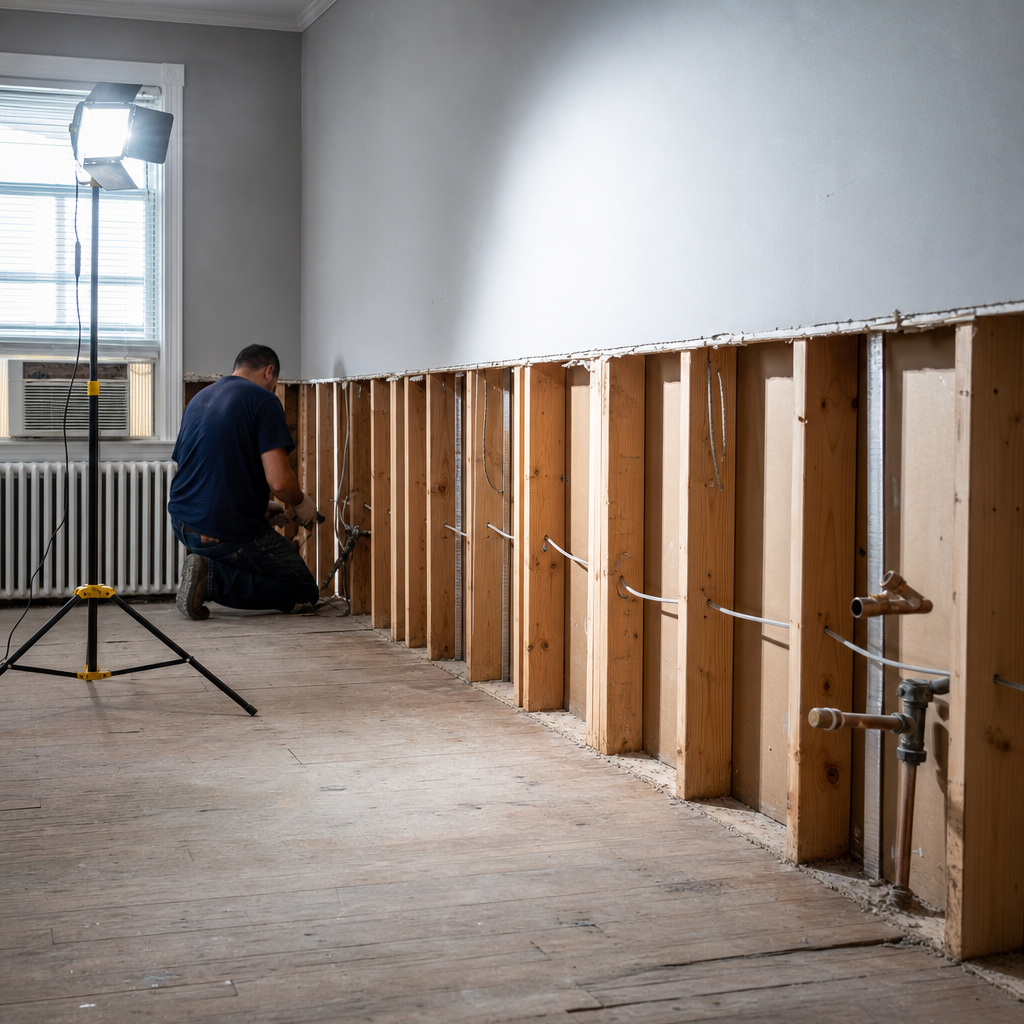
Whether drywall can be dried in place or must be replaced depends on the water source, how quickly drying begins, and the physical condition of the gypsum board.
Drywall that has absorbed clean water can be dried in place if it remains structurally intact and work begins quickly. However, drywall that is swollen, moldy, has remained wet for an extended duration, or has been exposed to contaminated water cannot be salvaged and must be removed and replaced.
Assessing Ceilings, Insulation, and Wall Framing
Water-damaged ceilings represent an immediate falling hazard. When overhead pipes leak, pooling water gathers on the top side of ceiling sheetrock. As gypsum absorbs water, it softens and pulls through screw heads, leading to sagging panels that can collapse without warning. If a ceiling shows visible sagging, water rings, or screw pop-outs, technicians relieve the pressure, remove the saturated panels, and dry the joists from above.[3]
The restoration team at Wade’s Restoration evaluates three components during every inspection:
- Gypsum Wallboard: Panels showing soft cores, swollen seams, bubbling paint, or paper separation require removal and disposal.
- Cavity Insulation: Fiberglass and cellulose insulation lose their thermal rating and mat down when wet, acting like wet sponges against wood framing. Wet insulation must be pulled to allow the wall studs to dry.
- Structural Studs and Plates: Wood framing absorbs moisture slowly and releases it slowly. Technicians check framing with pin-type moisture meters to confirm wood moisture content drops below 15% before any new drywall is hung.
The Step-by-Step Professional Restoration Process
Need drywall water damage repair in Bayonne?
We’re available now - call for a fast, free estimate.
Restoring water-damaged drywall involves a methodical process to protect indoor air quality and structural stability:
- Moisture Mapping: Technicians use infrared thermal cameras and non-penetrating moisture meters to find the exact boundaries of hidden water behind walls and under floors.
- Source Containment & Water Extraction: Active plumbing leaks are isolated, standing water is pumped out, and damaged baseboards are pulled to inspect the lower wall plates.
- Controlled Demolition: Saturated drywall is cut out cleanly along stud centers above the moisture line, giving technicians open access to the wall cavity.
- Antimicrobial Application: Exposed framing is cleaned and treated with EPA-registered antimicrobial solutions to inhibit fungal colonization.
- Structural Cavity Drying: High-velocity air movers and commercial LGR (Low Grain Refrigerant) dehumidifiers are positioned to circulate dry air through the open bays until wood framing meets dry standards.
- Reconstruction & Finishing: Fresh sheetrock is hung, seams are taped and mudded with multiple coats, sanded smooth, primed, and painted to match the surrounding room.
Frequently Asked Questions About Bayonne Drywall Repair
How much does drywall water damage repair cost in Bayonne NJ?
Specific local pricing for Bayonne is not directly documented. Costs depend on whether the repair is a small patch from an isolated drip or an extensive tear-out following a major pipe burst. Factors influencing the final estimate include the linear footage of drywall replaced, accessibility of the wall cavities, ceiling height, and drying equipment run times.
Can water-damaged drywall be salvaged, or must it be replaced?
Drywall can be dried in place if it remains intact, was exposed only briefly to clean water, and is dried quickly. If the drywall is swollen, moldy, contaminated, or has remained wet for an extended period, it must be removed and replaced.
How quickly does mold develop behind wet drywall after a leak?
Microscopic mold spores exist naturally in indoor air. When sheetrock paper and framing wood stay damp, mold can begin germinating within 24 to 48 hours. Quick extraction and cavity ventilation stop this growth cycle before mold penetrates structural elements.
Does homeowners insurance cover water-damaged ceiling and wall drywall repair?
Most standard homeowners policies cover drywall and ceiling repairs caused by sudden and accidental events, such as a frozen pipe rupture or an appliance supply line failure. Gradual damage from neglected maintenance is typically excluded. Professional restoration teams like Wade’s Restoration document moisture readings, take date-stamped photos, and coordinate with insurance adjusters using standard estimating software.
How do I know if wet drywall is structural or hazardous?
Drywall itself is not load-bearing, but wet drywall on a ceiling can drop suddenly under the weight of trapped water. Additionally, if the sheetrock is soft around electrical outlets or light switches, electrical shock hazards may exist. If walls are bowing, ceilings are sagging, or water has contacted electrical runs, turn off power to the area and contact a professional restoration crew immediately.
Need Immediate Drywall Water Damage Repair in Bayonne?
Do not let trapped moisture ruin framing or create hidden mold colonies. Contact a qualified local water damage restoration professional such as Wade’s Restoration for emergency response, thermal moisture mapping, and complete structural repair.
Need drywall water damage repair in Bayonne?
We’re available now - call for a fast, free estimate.
Sources
- [PDF] State of New Jersey 2024 All-Hazard Plan – NJ.gov – nj.gov (2025)
- [PDF] Current and Future Flood Exposure to New Jersey Properties and … – njclimateresourcecenter.rutgers.edu (2025)
- 6 Months Report: Superstorm Sandy from Pre-Disaster to Recovery – fema.gov (2013)
- Natural Hazards | U.S. Geological Survey – usgs.gov
- Barely Above Water | Climate Central – climatecentral.org (2050)
Related reading: Ceiling Water Damage Repair in Jersey City – Call Now-10% Off – On-Site in 60 Minutes – Free Estimate
Related reading: Water Damage Restoration in Bayonne – 10% Off & Free Estimate – Same-Day Service
Related reading: Water Damage Restoration in West New York – Call Now-10% Off – Same-Day Service – Free Estimate
Frequently Asked Questions
How do you detect and dry water traveling up older balloon-framed walls in Bayonne?
Because balloon framing allows moisture to migrate vertically across multiple stories, Wade's Restoration utilizes infrared thermal imaging cameras and precision borescopes to inspect upper cavities. Technicians then deploy targeted cavity drying systems and air injection into the wall bays without unnecessarily demolishing intact drywall or plaster on higher floors.
How long does the entire drywall water damage restoration process usually take?
Structural cavity drying with commercial dehumidifiers and air movers typically takes 3 to 5 days, followed by 2 to 4 days for drywall hanging, taping, sanding, and painting. Wade's Restoration ensures that wood framing reaches a safe moisture level below 15% before initiating reconstruction to prevent future mold growth.
How can I schedule a moisture assessment and get a fixed-price drywall repair estimate in Bayonne?
You can contact Wade's Restoration directly to arrange an emergency visit for a free visual inspection and thermal moisture mapping. Their certified technicians will assess cavity damage, verify framing saturation, and deliver a comprehensive fixed-price estimate formatted for insurance claims.
About the author
 |
Daniel Preston Daniel Preston is a certified structural drying expert with over 12 years of experience in disaster restoration across the New York metropolitan area. Holding an Environmental Science degree from Rutgers University, he specializes in rapid response strategies for water damage mitigation, mold remediation, and fire recovery. Daniel combines his technical knowledge with a practical approach to help property owners navigate the complexities of emergency restoration and insurance claims. |
Water damage, flood, or mold emergency?
We’re available now - call for a fast, free estimate.
Call Now - Free Estimate