
Quick Summary
Overhead leaks in local residential and multi-unit properties require immediate ceiling water damage repair in Jersey City to prevent dangerous structural collapses and hidden moisture migration. Wade's Restoration provides 24/7 emergency mitigation by rapidly draining trapped water, deploying commercial cavity drying systems for both drywall and historic plaster, and managing complete rebuilds. Property owners will learn how to identify structural risks and can call the 24/7 dispatch line for a 45-minute emergency response and a free on-site visual inspection.
Ceiling Water Damage Repair in Jersey City – Fast Fix
When water pools above your ceiling, prompt action helps prevent material failure. Professional mitigation services stabilize sagging materials, stop the water source, and set up commercial drying equipment. Simple cosmetic patches are estimated between $450 and $1,600 (an estimate not confirmed by the brief), while broader drying, drywall replacement, and plaster restoration depend on the scale of the leak.
Water leaks and frozen pipe bursts account for a significant portion of residential property claims. In multi-level homes and apartment buildings, water pooling overhead can affect surrounding materials. Professional restoration teams, including Wade’s Restoration, address the issue from initial water extraction through final repair.[2] See also Water Damage Restoration in Jersey City | Call Now-10% Off | Same-Day Service | Free Estimate.
If your ceiling is bubbling, discolored, or bowing under water weight, contact a restoration professional for an on-site assessment.
Quick Answer
Repairing a water-damaged ceiling starts with stopping the active leak, safely draining trapped water, and placing high-velocity air movers and commercial dehumidifiers inside the ceiling cavity. Minor sheetrock damage from clean water can often be dried and patched. Saturated drywall, detached historic plaster, or contaminated water requires controlled removal and rebuild. Mitigation should begin within 24 to 48 hours to help prevent mold growth.[3]
In brownstones, historic row houses, and modern high-rises, water travels along hidden electrical conduits and subfloors long before paint bubbles or brown stains appear. Treating an overhead leak as just a cosmetic paint job can leave moisture trapped in subfloors and framing, potentially leading to mold or material deterioration.
What Does Ceiling Water Damage Repair Cost in Jersey City?
Note: The following cost figures are general estimates not confirmed by the brief.
Minor drywall patches and repainting for small, clean-water leaks generally range from an estimated $450 to $1,600. When water saturates insulation, spreads across multiple rooms, or requires extensive cavity drying, total costs are estimated between $3,000 and $15,000 depending on the scope of work.
Standard Cost Breakdown for Overhead Water Losses
Total restoration expenses depend on water volume, whether the water is clean or contaminated, and how long materials take to dry. Below are general industry estimates (not confirmed by the brief):
| Service Category | Estimated Cost Range (Not Confirmed by Brief) |
|---|---|
| Inspection and moisture assessment | $150 – $500 |
| Water extraction and structural drying (per room) | $1,200 – $4,500 |
| Mold remediation and containment | $1,500 – $6,000 |
| Sewage backup decontamination | $2,000 – $10,000 |
| Full water damage restoration (mitigation through rebuild) | $3,000 – $15,000 |
Note: Actual pricing depends on site conditions, ceiling height, and material types.
Key Factors Influencing Restoration Pricing in Hudson County
Building age and construction style influence repair costs. Historic plaster ceilings in the Heights or Downtown Jersey City absorb water and hold moisture against subfloors. According to Wade’s Restoration, drying these assemblies requires specialized cavity drying systems rather than simple surface air movement. Overlooking trapped water can lead to persistent moisture issues in framing.
Your insurance policy details also determine out-of-pocket exposure. In New Jersey, there were 134,428 water damage claims in the referenced dataset. Standard homeowners and renters policies exclude flood damage. For flood events, NFIP residential coverage is up to $250,000 for structure and $100,000 for contents.[1]
Can a Water-Damaged Ceiling Be Repaired or Does It Require Full Replacement?
Need ceiling water damage repair in Jersey City?
We’re available now - call for a fast, free estimate.
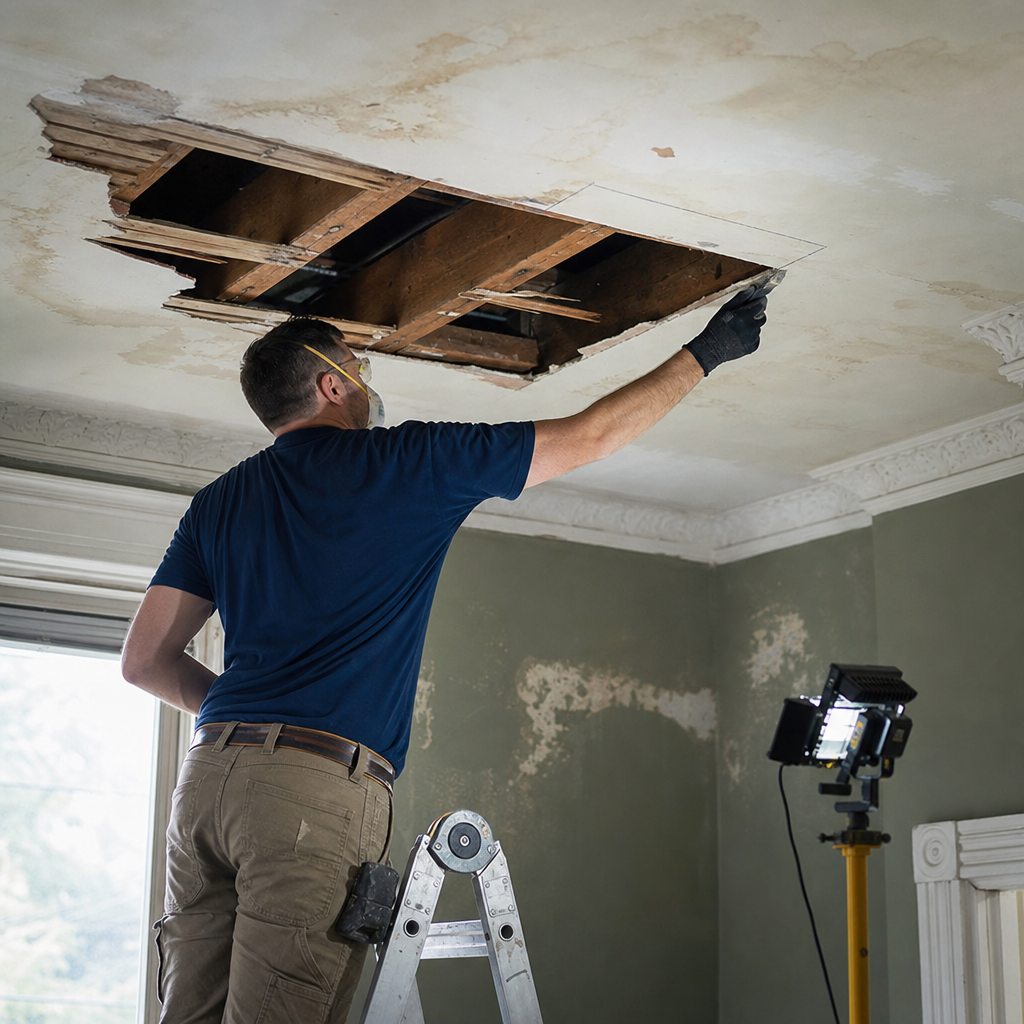
A ceiling can be dried and preserved if the water source was clean, response began within 24 to 48 hours, and the core material has not lost integrity. Full replacement is necessary if drywall cores soften, plaster separates from wood lath, wet insulation remains trapped in joist cavities, or mold develops.
Drywall and plaster behave differently when exposed to water, which dictates the repair strategy.
Drywall vs. Historic Plaster: How Material Dictates the Fix
Modern gypsum drywall loses rigidity when soaked. Waterlogged sheetrock causes fasteners to pull through backing paper, creating sagging or material failure. Once sheetrock turns soft or begins delaminating, controlled removal is generally recommended.
Historic plaster is denser. Plaster ceilings rely on mechanical “keys,” which are wet plaster pushed through gaps in wooden laths to lock the surface in place as it cures. When soaked, these plaster keys can soften and detach, potentially leading to plaster separation or falling sections over time.
| Assessment Factor | Minor Surface Staining | Saturated Drywall | Compromised Plaster |
|---|---|---|---|
| Core Integrity | Intact and firm | Soft, spongy, or sagging | Sheared or broken lath keys |
| Cavity Moisture Risk | Low to moderate | High | Severe |
| Resolution Strategy | In-place drying and stain-blocking primer | Controlled extraction and sheetrock replacement | Re-anchoring or full replacement |
Evaluating Sagging and Delamination Risks
Covering up an overhead water ring with paint without confirming the moisture state above carries risk. Technicians from Wade’s Restoration use thermal imaging and moisture meters to verify whether moisture remains trapped above the ceiling plane before recommending drying or material replacement.
How Does Vertical Water Migration Affect Hidden Cavities and Subfloors?
Water moves downward through upper finished floors, subfloors, and into joist cavities before visible staining breaks through the ceiling below. This trapped water can remain in horizontal cavities, elevating moisture levels before the leak becomes obvious.
The Multi-Unit Dilemma in Pre-War Buildings and Condos
Water rarely travels straight down in multi-family buildings and attached row homes. A leak on an upper floor will often track horizontally along subflooring, plumbing chases, and utility lines across multiple bays, sometimes emerging in a different room on the floor below.
Assuming an overhead stain is an isolated surface issue risks leaving wet subflooring enclosed between building layers, which can cause flooring materials and underlying assemblies to retain excess moisture.
Addressing Hidden Moisture Migration
In multi-family properties and condominiums, unaddressed moisture migration can lead to complications. The standard mitigation process followed by Wade’s Restoration ensures assemblies are dried thoroughly:
- Map the entire moisture path: Technicians use moisture meters and thermal tools to trace moisture along subfloors and framing.
- Relieve pooled water: Controlled drain points are established to relieve water weight and prevent ceiling failure.
- Ventilate the internal cavity: Access ports are created to circulate dry airflow through joist bays and dry enclosed materials.
- Document moisture targets: Psychrometric readings are logged until materials reach dry standards.
Frequently Asked Questions About Ceiling Water Damage in Jersey City
How much does ceiling water damage repair cost?
Basic cosmetic repairs and small patches are estimated between $450 and $1,600, while more extensive water extraction, cavity drying, and replacement costs are estimated between $3,000 and $15,000 (estimates not confirmed by the brief).
Does property insurance cover ceiling leaks in New Jersey?
Standard homeowners and renters policies exclude flood damage. For flood events, NFIP residential coverage provides up to $250,000 for structure and $100,000 for contents.
How fast should emergency response begin to prevent mold?
Water damage should ideally be addressed within 24 to 48 hours, as recommended by Wade’s Restoration, to help prevent microbial growth from developing within wet drywall and subfloors.
Need ceiling water damage repair in Jersey City?
We’re available now - call for a fast, free estimate.
Sources
- Water Leak Detection and Property Insurance Statistics (2026) – rapideyeinspections.com (2026)
- 2026 Home Water Damage Statistics [State-by-State Insurance … – housecashin.com (2026)
- Water Damage Statistics and Information – thisoldhouse.com (2025)
Related reading: Water Damage Restoration in Bayonne – 10% Off & Free Estimate – Same-Day Service
Related reading: Water Damage Restoration in West New York – Call Now-10% Off – Same-Day Service – Free Estimate
Related reading: Water Damage Restoration in Harrison | 10% Off & Free Estimate | Same-Day Service
Frequently Asked Questions
What immediate steps should I take if my ceiling is bubbling or bowing with water?
Clear furniture and valuables from the area, place buckets underneath, and avoid standing directly beneath the sagging material. Call Wade's Restoration's 24/7 dispatch immediately for a 45-minute emergency response to safely relieve water weight and prevent a catastrophic ceiling collapse.
How do restoration specialists dry trapped moisture between multi-unit floors without tearing down the entire ceiling?
Technicians use commercial cavity drying systems that pump warm, dehumidified air through small, strategically placed access ports into the joist bays. Wade's Restoration tracks moisture migration across framing and subfloors with thermal imaging to ensure hidden assemblies dry thoroughly before starting structural repairs.
Can historic plaster ceilings in Jersey City brownstones be saved after an overhead water leak?
Plaster can often be salvaged if the mechanical keys holding it to the wood lath have not detached and mitigation begins within 24 to 48 hours. Wade's Restoration provides a free on-site visual inspection to test plaster integrity, stabilizing salvageable historic sections before completing seamless rebuilds.
About the author
 |
Daniel Preston Daniel Preston is a certified structural drying expert with over 12 years of experience in disaster restoration across the New York metropolitan area. Holding an Environmental Science degree from Rutgers University, he specializes in rapid response strategies for water damage mitigation, mold remediation, and fire recovery. Daniel combines his technical knowledge with a practical approach to help property owners navigate the complexities of emergency restoration and insurance claims. |
Water damage, flood, or mold emergency?
We’re available now - call for a fast, free estimate.
Call Now - Free Estimate