
Quick Summary
High-rise plumbing failures, pressurized riser bursts, and sub-basement flooding require immediate emergency water damage restoration in the Financial District to prevent severe structural decay and mold growth. Wade's Restoration provides 24/7 rapid emergency dispatch and specialized structural drying tailored to the complex infrastructure, masonry vaults, and utility chases of Lower Manhattan. Property managers and owners can call Wade's Restoration 24/7 to secure immediate emergency response, arrange a free on-site visual inspection, and obtain complete insurance claims documentation.
Emergency Water Damage Restoration in Financial District
When clean water supply lines break on upper floors or storm runoff enters a commercial basement, property owners often seek emergency water damage restoration services in the Financial District. Water can travel quickly in dense urban buildings, moving through drywall, running down utility chases, and reaching subflooring. Restoration providers typically offer services ranging from extraction and moisture mapping to structural drying and repairs; property managers and owners should confirm specific services, staffing, equipment, and certifications directly with the company.[5]
According to a 2024 analysis by the NYC Economic Development Corporation (NYCEDC), the study area faces projected coastal and stormwater flood exposure over coming decades, though this general projection does not establish flood risk at every individual property. Because high-rises and below-grade spaces present unique structural considerations, timely professional mitigation from specialists like Wade’s Restoration can assist in addressing moisture intrusion and secondary damage risks. Contact local restoration providers directly to verify availability and dispatch procedures.[1] See also Water Damage Restoration in Jersey City | Call Now-10% Off | Same-Day Service | Free Estimate.
Rapid Response for High-Rises and Commercial Basements
Direct emergency assistance: Emergency water damage restoration in the Financial District generally focuses on water removal, structural drying, and dehumidification. Wade’s Restoration claims its technicians stabilize active leaks, dry sub-basements, salvage building materials, and provide documentation for insurance carriers; property owners should confirm specific technician certifications, capabilities, and availability directly with the provider.
Plumbing failures in Lower Manhattan can involve pressurized risers or aging infrastructure. When a high-pressure line breaks on an upper floor, water may descend through elevator shafts, electrical conduits, and shared ceilings. At street level and below, masonry foundations and mechanical rooms may hold moisture under hydrostatic pressure. Service providers often deploy extraction units and desiccant dehumidifiers to manage water spread across affected areas.
How Fast Can an Emergency Water Restoration Team Arrive in the Financial District?
Arrival times depend on the specific provider, building access requirements, traffic conditions, and the circumstances of the incident. Property owners and facility managers should contact the service provider directly to confirm estimated arrival times for their location.
What to Do While Restoration Crews Are En Route
Taking safety steps while awaiting professional assistance helps protect occupants and contain damage:
- Shut off the water: Close the local isolation valve or main building intake valve immediately if you can safely reach it.
- Address electrical risks: Avoid standing water and wet electrical equipment. Turn off electricity at the main breaker only if the panel is dry and safe to access. Notify building management, and call 911 if water is entering electrical wiring or electrical components.
- Prepare the building: Inform security or building staff to clear loading dock space and coordinate designated freight elevator access so crews can move equipment to affected areas upon arrival.
Managing Logistics in Lower Manhattan
Working in the Financial District requires navigating street grids, loading zones, and building access protocols. The NYC flood-hazard dataset provides location-specific flood zone information, including Financial District and Battery Park City locations classified as areas of minimal flood hazard as well as locations classified as 0.2% annual-chance flood zones. However, general neighborhood classifications do not establish risk for every individual property. Restoration providers typically adapt drying equipment configurations for multi-story residential towers, commercial offices, and below-grade areas.[4]
Restoring Sub-Basements, Hardwood Floors, and High-Rise Drywall
Need emergency water damage restoration in Financial District?
We’re available now - call for a fast, free estimate.
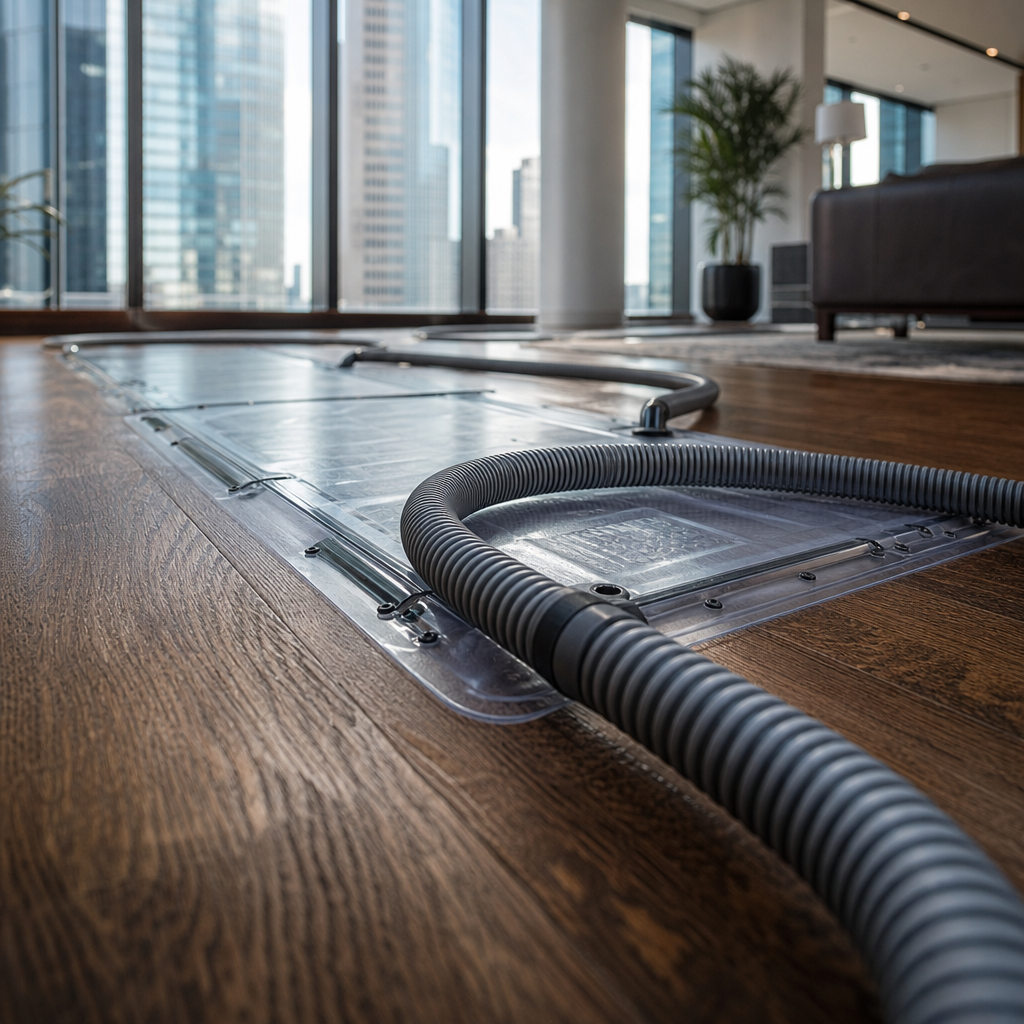
Structural drying often utilizes non-invasive moisture meters and thermal imaging to help identify moisture paths through cavities, concrete slabs, and structural assemblies.
Below-Grade Mechanical Vaults and Historic Masonry
The NYC Economic Development Corporation 2024 analysis evaluated coastal and stormwater exposure within its study area, indicating that below-grade structures and mechanical areas in Lower Manhattan may require specialized mitigation strategies. Sub-basements constructed with dense stone and concrete can absorb water during major storm surges or water main breaks. Restoration contractors like Wade’s Restoration often utilize industrial desiccant dehumidification systems designed to reduce ambient humidity and assist in drawing moisture out of structural masonry.[2]
Drying Hardwood Flooring and Wall Cavities
Depending on the extent of water exposure and material condition, specialized drying methods may help preserve certain structural elements without immediate removal:
- Floor drying systems: Suction extraction panels may be applied to draw moisture through the seams of hardwood floors to mitigate warping if deployed before irreversible damage occurs.
- Cavity wall drying: Placing small access ports behind baseboards allows warm, dry air to be directed into wet wall cavities, which may reduce the need for extensive drywall removal.
- Psychrometric monitoring: Technicians monitor relative humidity, temperature, and moisture levels throughout the project to assess drying progress against baseline standards.
Addressing Shared Air Systems and Moisture
When water in high-rise buildings travels along vertical utility chases, it can contact ductwork and insulation. Unaddressed moisture in warm environments can encourage microbial growth over time. Restoration protocols may include isolating affected HVAC zones, deploying HEPA air filtration devices, and applying EPA-registered antimicrobial treatments where appropriate.
What Does Emergency Water Damage Restoration Cost in the Financial District?
The cost of emergency water mitigation depends on the water source, contamination level, volume, structural materials affected, and how far moisture has migrated through the building. A clean supply line break addressed immediately typically involves lower costs than a contaminated drain backup or a flooded basement requiring extensive extraction and sanitation. An industry-market benchmark of $3,650 (2026 figure) represents an overall reference point and is not a property-specific quote. All figures below are unverified estimates, and an on-site evaluation is required for property-specific pricing.
Typical Restoration Cost Ranges (Unverified Estimates)
As regional context, Central Park recorded 2.64 inches of rain during the July 14-15, 2025 storm according to ABC7 New York (note: this is a regional measurement and not specific to the Financial District). Water contamination categories influence the required labor, safety equipment, and containment protocols:[3]
| Factor | Category 1 (Clean Water) | Category 2 (Grey Water) | Category 3 (Black Water / Storm) |
|---|---|---|---|
| Estimated Range (Unverified Estimates; Variable by Project Scope) | $1,500 – $3,500 | $3,000 – $7,000 | $7,000 – $15,000+ |
| Common Sources | Supply risers, domestic lines | Appliance discharge, sump pump overflow | Sewage backups, street flooding, storm runoff |
| Typical Impact | Drywall saturation, wet surface flooring | Contaminated subflooring, carpet padding | Mechanical rooms, electrical areas, masonry |
| Primary Equipment | LGR dehumidifiers, centrifugal air movers | Cavity drying systems, antimicrobial agents | Desiccant dehumidifiers, HEPA filtration, safety PPE |
Handling Commercial and Residential Insurance Claims
Navigating insurance coverage following water damage depends heavily on the specific policy terms and the underlying cause of the loss. Sudden and accidental internal water damage may be covered under standard property policies, whereas flood damage is commonly excluded from standard commercial property insurance and may require separate flood insurance coverage.
Restoration providers like Wade’s Restoration frequently work with insurance adjusters by supplying drying logs, scope sheets, moisture mapping, and line-item documentation to assist property owners during the claims process.
Frequently Asked Questions
Does commercial property insurance cover emergency water damage mitigation?
Coverage depends entirely on your specific policy and the cause of the damage. Sudden and accidental internal water damage may be covered by standard commercial policies, while flood damage is commonly excluded and may require separate flood insurance. Consult your insurance representative to verify coverage terms, and request detailed moisture logs and documentation from your restoration provider to support any claim.
How do crews handle water extraction in multi-story Financial District towers?
In high-rise buildings where truck-mounted equipment cannot reach upper levels, technicians typically transport portable extraction units, air movers, and dehumidification equipment via freight elevators to conduct localized water extraction and drying on the affected floors.
Are emergency water mitigation services available 24/7 on weekends and holidays?
Wade’s Restoration advertises 24/7 emergency dispatch availability, including weekends and holidays. Property owners should verify current staffing, response capabilities, and estimated arrival times directly with the company when requesting service.
Need emergency water damage restoration in Financial District?
We’re available now - call for a fast, free estimate.
Sources
- Urban Climate – ntrs.nasa.gov (2015)
- PowerPoint Presentation – nyc.gov (2015)
- Transcript: Mayor Adams Briefs the Media on Last Night's … – nyc.gov
- water – assets.firststreet.org (2051)
- Mitigation Actions Map – nychazardmitigation.com (2021)
Related reading: Emergency Water Damage Restoration in Jersey City – 10% Off & Free Estimate – On-Site in 60 Minutes
Related reading: Emergency Water Damage Restoration in Bayonne – Call Now-10% Off – On-Site in 60 Minutes – Free Estimate
Related reading: Water Damage Restoration in Bayonne – 10% Off & Free Estimate – Same-Day Service
Frequently Asked Questions
What occurs during Wade's Restoration's free on-site visual inspection in the Financial District?
During the inspection, technicians use non-invasive thermal imaging and moisture meters to map hidden water migration across drywall, slabs, and utility chases. Wade's Restoration then develops a customized structural drying protocol and provides line-item documentation for your insurance provider.
How quickly does secondary damage or mold develop after a pipe burst in Lower Manhattan?
Microbial growth and mold colonization can begin within 24 to 48 hours of water exposure inside enclosed wall cavities and mechanical vaults. Wade's Restoration mitigates this risk by deploying rapid desiccant dehumidification, HEPA air filtration, and EPA-registered antimicrobial treatments immediately upon dispatch.
Does Wade's Restoration provide full structural repairs after completing water extraction?
Yes, Wade's Restoration provides full-service solutions ranging from initial emergency water extraction and cavity drying to complete reconstruction of damaged drywall, subflooring, and masonry. Their team manages the entire recovery process while coordinating directly with insurance adjusters to streamline claims.
About the author
 |
Daniel Preston Daniel Preston is a certified structural drying expert with over 12 years of experience in disaster restoration across the New York metropolitan area. Holding an Environmental Science degree from Rutgers University, he specializes in rapid response strategies for water damage mitigation, mold remediation, and fire recovery. Daniel combines his technical knowledge with a practical approach to help property owners navigate the complexities of emergency restoration and insurance claims. |
Water damage, flood, or mold emergency?
We’re available now - call for a fast, free estimate.
Call Now - Free Estimate