
Quick Summary
Basement flood cleanup in the Financial District presents severe structural challenges, as high water tables and external hydrostatic pressure can destabilize historic foundations if standing water is pumped out too quickly. Wade's Restoration delivers rapid emergency mitigation using controlled phased extraction, non-destructive desiccant drying, and thermal mapping to protect sensitive utility vaults and load-bearing infrastructure. Property managers and owners can accurately evaluate restoration costs and call the 24/7 dispatch line for immediate flood extraction and a free on-site visual inspection.
Basement Flood Cleanup in Financial District – Fast Local Recovery
If you are dealing with an active water emergency, Wade’s Restoration provides emergency basement flood cleanup in the Financial District. Technicians extract standing water, decontaminate contaminated vaults, and salvage critical building infrastructure. As a general market estimate, emergency mitigation costs generally range from $1,500 to $8,000+ based on water depth, category of contamination, and accessibility.
Lower Manhattan‘s sub-grade architecture presents unique structural challenges. Historic rubble masonry, multi-level utility vaults, and post-Sandy mechanical systems require technical drying methods rather than aggressive demolition. When water enters a sub-grade vault near the harbor, rushing in with standard bulk trash pumps can destabilize the foundation walls due to surrounding soil pressure. Our local team works with the building stock of Lower Manhattan, deploying industrial drying systems, tracking psychrometric logs, and providing documentation to assist with property insurance claims. See also Water Damage Restoration in Jersey City | Call Now-10% Off | Same-Day Service | Free Estimate.
Standing water can quickly degrade masonry foundations, corrode electrical switchgear, and trigger mold growth. Contact our dispatch line to speak with a representative and schedule an on-site inspection.
Fast Emergency Response for Financial District Flooding
When water floods a Financial District basement or commercial vault, prompt action is necessary, but the extraction must be controlled. Lower Manhattan sits directly alongside high-tide river corridors. If you pump out a flooded basement too quickly while the surrounding ground is fully saturated, the inward pressure from the wet earth can bow, crack, or damage historic foundation walls.
Slowly draining flooded basements can help reduce structural risk during severe flood events. Technicians balance water removal rates against surrounding hydrostatic pressure, combining phased water extraction with high-capacity desiccant dehumidifiers and EPA-registered antimicrobials to protect structural masonry, timber joists, and mechanical equipment.[3]
What Does Basement Flood Cleanup Cost in the Financial District?
Need basement flood cleanup in Financial District?
We’re available now - call for a fast, free estimate.
As a general market estimate, basement water restoration costs depend heavily on the source of the water, its contamination level, the depth of flooding, and the complexity of your sub-grade layout. Clean water from a supply pipe requires fewer safety steps than black water from a storm surge or city sewer backup.[1]
Typical Cost Breakdown by Water Category (General Market Estimates)
| Feature | Category 1 (Clean Water) | Category 2 (Grey Water) | Category 3 (Black Water / Sewage / Surge) |
|---|---|---|---|
| Estimated Cost Range | $1,500 – $3,500 | $2,500 – $6,000 | $5,000 – $8,000+ |
| Pumping Protocol | Direct extraction | Controlled extraction & sanitization | Phased pumping, bio-wash & antimicrobial treatment |
| Drying Duration | 2-3 days | 3-5 days | 5-7+ days (Desiccant systems) |
| Typical Coverage | Standard pipe break coverage | Sump pump or appliance endorsement | Commercial flood policy / NFIP required |
Key Factors Driving Restoration Costs in FiDi
Several local factors influence the total project cost for Lower Manhattan properties:
- Sub-Basement Depth and Access: Deep multi-level basements require specialized high-lift pumping systems and remote power generation.
- Water Classification: Category 3 storm surges and municipal sewer backups require strict containment zones, personal protective equipment, and full biohazard sanitization.
- Structural Composition: Century-old stone, brick, and heavy timber require longer, non-destructive desiccant drying cycles compared to modern drywall assemblies.
Across New York City, basement flooding risk is concentrated more heavily in South and East Brooklyn, South Queens, the East Coast of Staten Island, and the East Bronx. In Lower Manhattan and the Financial District, flooding incidents primarily threaten commercial sub-basements, mechanical vaults, and mixed-use properties where business interruption and asset protection are central concerns.[2]
Note that FloodNet tracks street-level flooding only and does not measure indoor or basement flooding. Wade’s Restoration conducts an on-site visual inspection and provides an itemized scope of work before starting mitigation work.
Why Rapid Water Pumping Threatens Historic FiDi Foundations
The natural reaction to a flooded basement is to pump the water out as fast as possible. In the Financial District, this approach can increase structural risks.
The Hydrostatic Pressure Trap
Lower Manhattan’s coastline sits on dense fill and porous soil with a high water table tied directly to ocean tides. When floodwaters rise outside a building, water saturates the surrounding ground. While your basement is full of water, that internal volume creates outward pressure that temporarily balances the weight of the waterlogged soil outside.[4]
If you rapidly pump all the water out in a matter of hours, you remove that internal counter-pressure while the external ground is still completely saturated. The immense hydrostatic pressure from the outside can push inward against the foundation, resulting in severe wall deflection, cracked masonry, or structural damage. Slowly draining flooded basements can help reduce structural risk and prevent sudden pressure imbalances.[5]
Salt-Wicking and Masonry Decay
Floodwater entering from the harbor or storm drains carries dissolved salts and corrosive minerals. Porous historic brick, mortar, and brownstone absorb this brine rapidly. If the space is dried incorrectly, moisture evaporates from the surface while leaving mineral salts trapped deep inside the wall. Over time, these salts expand and crystallize (a process called subflorescence), breaking down mortar joints from the inside out and causing chronic dampness.
Preventing long-term masonry decay requires controlled, phased extraction followed by deep industrial desiccant dehumidification that pulls moisture out of the wall cores without pulling exterior groundwater inward.
| Approach | Hydrostatic Risk | Structural and Masonry Impact |
|---|---|---|
| Uncontrolled Bulk Pumping | Severe; creates an immediate pressure imbalance | Wall displacement, cracked foundations, blown mortar joints |
| Controlled Phased Extraction | Low; water levels drop in sync with receding ground saturation | Protects foundation stability and prevents masonry shock |
Drying Commercial Subfloors, Joists, and Mechanical Rooms
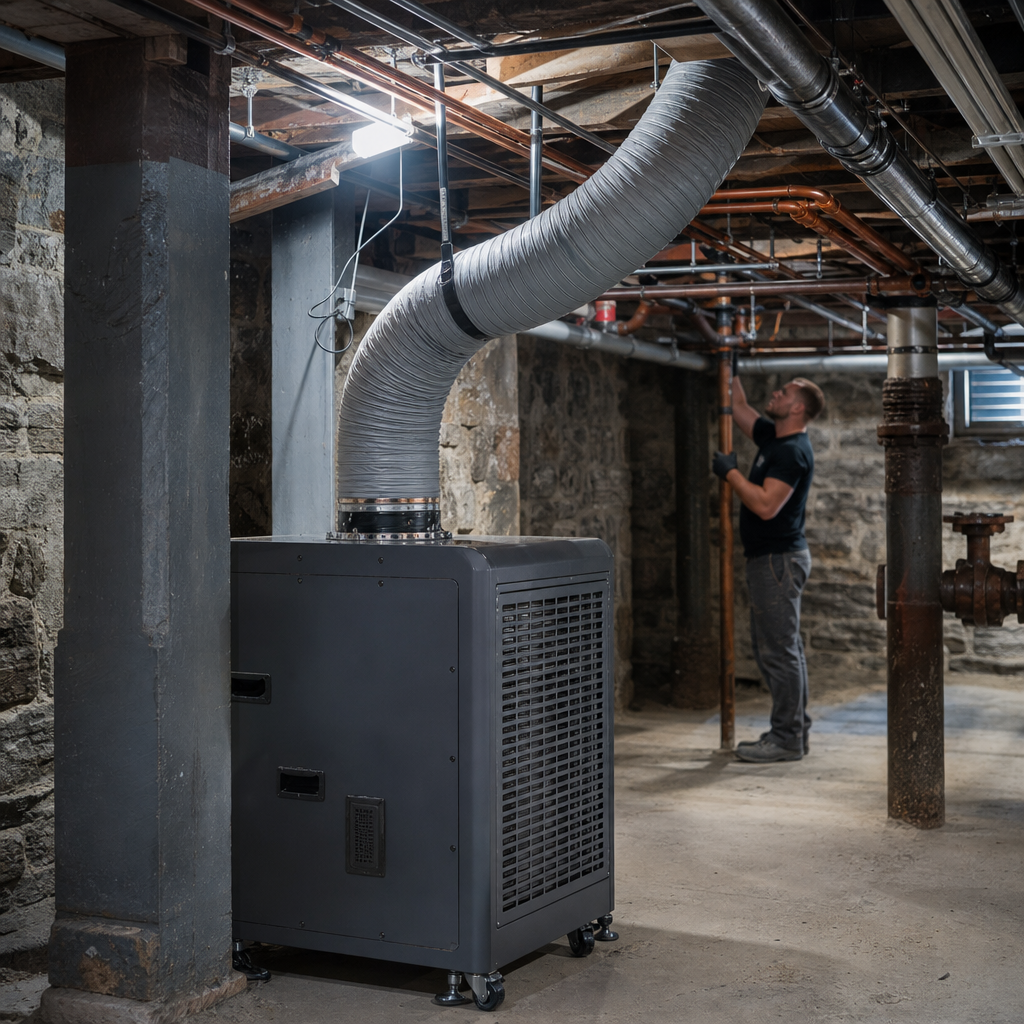
Commercial sub-grades in Lower Manhattan house vital building systems, including emergency switchgear, telecom lines, elevator pits, and HVAC machinery. Water damage restoration in these spaces requires targeted structural drying rather than destructive demolition.
Saving Historic Timber and Concrete Slabs
Instead of immediately tearing out historic structural materials, Wade’s Restoration technicians use moisture meters and thermal imaging to map the migration of water behind walls and beneath slabs. Setting up containment zones and deploying high-volume desiccant dehumidifiers helps draw trapped water out of concrete slabs and load-bearing timber beams safely.
Decontaminating Critical Utility Vaults
When floodwater breaches an electrical basement or mechanical vault, moisture creates an immediate risk of short circuits, corrosion, and microbial growth inside ductwork. Crews isolate the mechanical zones, clean affected surfaces with EPA-registered botanical antimicrobials, and maintain continuous airflow monitoring until moisture levels return to standard targets.
| Factor | Targeted Non-Destructive Drying | Standard Demolition Approach |
|---|---|---|
| Material Preservation | Saves original timber, slab subfloors, and finishes | Rips out drywall, flooring, and structural framing |
| Operational Downtime | Keeps facilities running with minimal disruption | Requires extended closures for demolition and rebuilding |
| Overall Expense | Controls total mitigation and replacement costs | Generates large construction and disposal fees |
Insurance Documentation for Lower Manhattan Property Claims
Need basement flood cleanup in Financial District?
We’re available now - call for a fast, free estimate.
Filing a water damage claim for a commercial facility or historic residential property can be complex. Insurance adjusters typically require documentation of the loss, verification of drying progress, and evidence showing whether the damage originated from an internal mechanical break, sewer backup, or surface flood.
Documentation for Property Claims
Wade’s Restoration provides project documentation during mitigation:
- Thermal Mapping: Moisture mapping documenting the spread of water behind walls, under floors, and inside utility chases.
- Daily Psychrometric Logs: Tracking of ambient temperature, relative humidity, and grains per pound (GPP) to monitor structural drying progress.
- Standardized Line-Item Scopes: Itemized estimates formatted to standard industry guidelines.
Commercial Endorsements vs. Flood Insurance
Determining whether water entered through a failed sump pump, broken domestic water line, or external storm surge dictates whether a loss is covered under standard property policies or a dedicated NFIP flood policy. Documenting the point of entry and water classification directly on site helps provide clarity when submitting claims.
Immediate Steps While Waiting for Flood Cleanup Crews
If you have standing water in your basement right now, take these safety precautions before cleanup begins:
- Prioritize Personal Safety: Do not enter a flooded basement if the water has reached electrical outlets, extension cords, or the main breaker panel. Call an electrician or the utility company to shut off power if it cannot be done safely from a dry area.
- Shut Off the Water Source: If the flood is caused by a burst supply pipe or heating line, locate and turn off the main water shut-off valve immediately.
- Avoid Category 3 Contamination: If water is dark, smells of sewage, or entered from the street, keep all occupants and pets away from the area. Wear protective boots and gloves if you must walk near the space.
- Do Not Use Household Shop-Vacs: Standard shop vacuums are not designed for bulk extraction and present serious electrocution risks in standing water.
- Document Visible Damage: Take initial photographs and video footage of standing water levels, submerged equipment, and damaged inventory for your insurance records.
Frequently Asked Questions
How quickly can a restoration crew arrive at my Financial District property?
Wade’s Restoration provides emergency dispatch for Lower Manhattan. Response and arrival times vary depending on weather conditions, traffic, and emergency call volume across the Financial District and Battery Park City.
What is the average cost of basement flood cleanup and water extraction?
Based on general market estimates, basic clean-water extraction and drying typically starts between $1,500 and $3,500. Large-loss commercial basements or Category 3 black water incidents involving sewage or storm runoff generally range from $5,000 to $8,000+, depending on structural depth, drying requirements, and biohazard protocols.
Does commercial or property insurance cover basement flood cleanup?
Coverage depends on the water source. Internal plumbing failures, broken pipes, and sprinkler malfunctions are typically covered under standard property policies. Storm surges and rising harbor waters require a separate flood policy through the National Flood Insurance Program (NFIP) or a private flood endorsement. Sewer backups usually require a specific water backup rider.
How do professionals remove water and prevent mold growth?
Technicians use submersible pumps and extraction units for phased water removal, followed by air scrubbers, EPA-registered antimicrobials, and commercial desiccant dehumidifiers. This draws moisture out of concrete, brick, and framing to return the indoor environment to safe moisture levels.
Are emergency services available for commercial facilities?
Yes. Emergency response services are available for commercial facilities to provide containment, water extraction, and structural drying, helping to mitigate operational downtime and protect mechanical assets. Contact our dispatch line for basement flood cleanup in the Financial District.
Need basement flood cleanup in Financial District?
We’re available now - call for a fast, free estimate.
Sources
- Street Flooding Events Measured by FloodNet Sensors – catalog.data.gov (2026)
- Building Performance: – fema.gov (2022)
- Bringing Basement Apartments Into the Light – Office of the New … – comptroller.nyc.gov
- New York City's Basement Residents Face Financial Risk of Floods – bloomberg.com
- Community Development: Resilience – FEDERAL RESERVE BANK … – newyorkfed.org (2023)
Related reading: Drywall Water Damage Repair in Bayonne | 10% Off & Free Estimate | On-Site in 60 Minutes
Related reading: Water Damage Restoration in Bayonne – 10% Off & Free Estimate – Same-Day Service
Related reading: Water Damage Restoration in West New York – Call Now-10% Off – Same-Day Service – Free Estimate
Frequently Asked Questions
How does controlled phased water extraction prevent structural foundation collapse in Lower Manhattan basements?
Rapid bulk pumping removes internal counter-pressure while surrounding soil remains saturated, allowing immense external hydrostatic pressure to bow or crack historic stone and brick foundations. Wade's Restoration employs controlled, phased extraction calibrated against surrounding tide and groundwater levels to protect structural masonry. Property owners facing active intrusion can contact our 24/7 dispatch line for immediate assessment.
How are flooded commercial utility vaults and elevator pits remediated without extensive demolition?
Deep sub-grade systems require specialized high-lift extraction units, non-conductive drying protocols, and EPA-registered botanical antimicrobials to eliminate corrosion and microbial risks. Wade's Restoration utilizes industrial desiccant dehumidification and thermal imaging to draw moisture out of concrete slab foundations and structural framing without tearing out essential mechanical infrastructure.
What specific documentation is required to file a successful commercial flood insurance claim in the Financial District?
Insurance adjusters need verified points of entry, water classification data, and daily psychrometric logs showing temperature, relative humidity, and grains per pound to approve mitigation coverage. Wade's Restoration compiles standardized line-item scopes, moisture mapping records, and water classification reports to help facility managers navigate complex commercial claims.
About the author
 |
Daniel Preston Daniel Preston is a certified structural drying expert with over 12 years of experience in disaster restoration across the New York metropolitan area. Holding an Environmental Science degree from Rutgers University, he specializes in rapid response strategies for water damage mitigation, mold remediation, and fire recovery. Daniel combines his technical knowledge with a practical approach to help property owners navigate the complexities of emergency restoration and insurance claims. |
Water damage, flood, or mold emergency?
We’re available now - call for a fast, free estimate.
Call Now - Free Estimate