
Quick Summary
Properties across Lower Manhattan face complex water intrusion risks that threaten historic architectural materials, subterranean basements, and high-rise commercial structures. Wade's Restoration provides 24/7 water damage restoration in Lower Manhattan, using advanced in-place structural drying and rapid extraction to protect original building components and prevent severe secondary damage. Readers can immediately implement critical emergency shut-off steps and contact Wade's Restoration for 24/7 rapid dispatch or a free on-site visual inspection.
Water Damage Restoration in Lower Manhattan – 24/7 Fast Repair
When water enters a property in Lower Manhattan, prompt action and appropriate equipment help protect interiors and structural components. Historic cast-iron lofts in Tribeca, century-old brownstones, and Financial District high-rises present distinct structural conditions. From subterranean vaults to multi-story vertical risers, handling water loss downtown requires professional extraction and drying equipment.[4]
Lower Manhattan remains uniquely vulnerable to water intrusion. Beyond severe storm surges, projected sea level rise means low-lying areas increasingly face flooding during regular high tides. Property owners can monitor real-time neighborhood street flooding via the NYC FloodNet program or review site-specific risks using the NYC Flood Hazard Mapper. When water penetrates a property, professional mitigation from specialists like Wade’s Restoration stabilizes the environment, extracts moisture from building materials, and protects the structure.[1] See also Water Damage Restoration in Jersey City | Call Now-10% Off | Same-Day Service | Free Estimate.
Emergency restoration services provide assistance across downtown Manhattan. Teams arrive equipped to extract standing water, set up drying equipment, track moisture conditions, and manage structural repairs.
Immediate Steps to Take During a Lower Manhattan Water Emergency
The actions taken immediately following water intrusion can help limit secondary damage to the property and adjacent units.
Immediate safety and stabilization priorities
- Shut off the water source: Locate your unit’s main shutoff valve immediately. In multi-family buildings or commercial spaces, notify building management to shut down the main riser if the leak originates from an upper floor or common pipe.
- Isolate electrical hazards: If it is safe to access the main breaker panel without stepping in water, switch off power to the affected rooms. Water seeping through ceilings and baseboards can contact electrical conduit, posing electrocution and fire risks.
- Alert building management and neighbors: In dense downtown structures, water can travel down vertical chases, elevator shafts, and concrete slabs into lower-level residences or commercial suites. Prompt communication helps prevent compounding damage.
- Document everything before cleanup: Take photos and videos of standing water, water lines on walls, affected baseboards, and damaged personal property before mitigation crews begin extraction.
- Call a local restoration specialist: Contact a mitigation contractor equipped for downtown Manhattan properties with extraction and drying equipment.
How Fast Can Restoration Crews Respond in Downtown NYC?
No specific verified response time is available in the research brief. In Lower Manhattan, arrival and setup times depend on localized dispatch routes and downtown logistics. Transporting extraction equipment through tight streets in the Financial District or coordinating with commercial freight elevator schedules in Battery Park City requires local operational familiarity.[2]
Why early mitigation matters
Standing water can spread beyond the initial surface. Clean water from a broken supply line can migrate into subfloors, porous brick, and shared wall assemblies. In high-rises, water pooling on concrete floors can travel down conduit runs, fixtures, and structural columns into units below.[5]
Subterranean vaults and sub-basements also require stabilization. Elevated relative humidity in enclosed below-grade rooms can affect electrical systems, mechanical equipment, and surrounding masonry if not mitigated in a timely manner.
What Does Water Damage Restoration Cost in Lower Manhattan?
Need water damage restoration in Lower Manhattan?
We’re available now - call for a fast, free estimate.
Restoration costs depend on several factors: the category of water, the square footage affected, and the extent of moisture intrusion into building materials.
General restoration approaches
Historic properties often benefit from targeted structural drying rather than broad demolition where feasible, an approach utilized by Wade’s Restoration. In-place drying focuses on extracting water directly from existing materials, which can help limit rebuilding requirements.
| Restoration Capability | Basic Surface Extraction | Standard Demolition Approach | Structural In-Place Drying |
|---|---|---|---|
| Sub-Basement Vault Recovery | Limited | Partial | Supported |
| Historic Hardwood and Plaster Preservation | Limited | Limited | Supported |
| Moisture Monitoring | Basic | Standard | Comprehensive |
| General Process Focus | Surface water removal | Material removal and rebuild | In-place drying and stabilization |
Primary cost drivers for downtown properties
- Water category: Clean water from supply line leaks requires extraction and drying. Contaminated water from sewage backups or flood sources requires specialized containment, antimicrobial treatments, and protective safety protocols.
- Sub-grade depth and access: Multi-level commercial sub-basements require specialized dehumidification and ducting configurations to exhaust moist air to the exterior.
- Material complexity: Hardwood flooring, structural brick, and historic lath-and-plaster require controlled drying setups to manage moisture safely.
Structural Drying for Historic Floors and Sub-Basements
In Lower Manhattan pre-war buildings and lofts, targeted drying methods used by teams like Wade’s Restoration help minimize unnecessary demolition of original woodwork and architectural features.
Drying hardwood floors in place
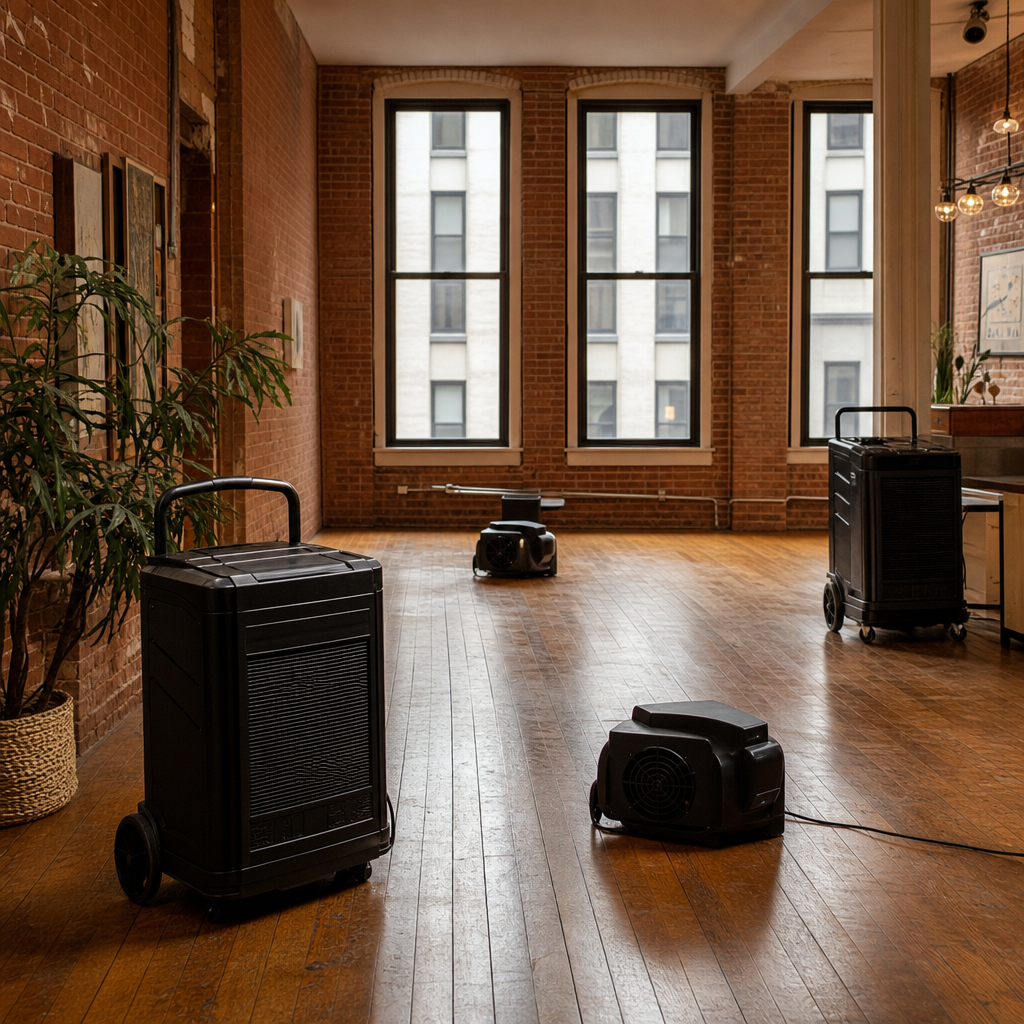
Specialized drying setups, such as floor mat systems connected to extraction units, draw moisture directly out of wood flooring and subfloors. Controlled air movement and dehumidification help stabilize the wood and reduce the extent of material replacement.
| Mitigation Method | Material Impact | Process Focus | Historic Preservation |
|---|---|---|---|
| Demolition and Rebuild | Removal of affected flooring and drywall | Reconstruction of building elements | Requires material replacement |
| Structural In-Place Drying | Targeted moisture extraction | In-place drying and stabilization | Aims to preserve existing materials |
Dehumidification for below-grade areas
Below-grade areas, elevator pits, and foundation vaults often require heavy-duty dehumidification equipment to manage high ambient humidity. These systems process humid air and vent moisture out of the structure, helping protect mechanical infrastructure and foundation masonry from prolonged moisture exposure.
Insurance Coverage for Water Damage
Flood insurance is separate from standard homeowners or renters coverage, and standard policies generally do not cover flood loss.[3]
Frequently Asked Questions About Lower Manhattan Water Damage
How much does emergency water damage restoration cost in Lower Manhattan?
Costs vary depending on the category of water, the affected area, and the scope of equipment required. An on-site assessment determines the specific requirements and scope of work for the property.
Can historic hardwood floors be saved after a water leak?
In many cases, prompt in-place drying and dehumidification can draw moisture out of hardwood and subflooring, helping stabilize the material and reducing the need for full floor replacement.
How quickly does mold develop after a water leak?
Mold can begin to develop on damp surfaces when moisture remains unaddressed. Rapid water extraction and structural drying are essential to help prevent mold growth in affected areas.
Do restoration companies handle commercial water extraction downtown?
Yes. Commercial properties across Lower Manhattan, including retail spaces, office buildings, and residential towers, have access to commercial water extraction and drying services from providers like Wade’s Restoration for both above-ground and below-grade areas.
Need water damage restoration in Lower Manhattan?
We’re available now - call for a fast, free estimate.
Sources
- Lower Manhattan Climate Resilience Study – NYC.gov – nyc.gov (2050)
- [PDF] FloodNet: Hyperlocal, street-level flood monitoring in New York City – nyc.gov (2023)
- [PDF] HURRICANE SANDY REBUILDING STRATEGY – hcr.ny.gov (2013)
- East Side Coastal Resiliency Updated Benefit-Cost Analysis – nyc.gov
- Chronic Tidal Flooding – Mayor's Office of Climate & … – nyc.gov
Related reading: Water Damage Restoration in Long Island City – Call Now-10% Off – Same-Day Service – Free Estimate
Related reading: Water Damage Restoration in Bayonne – 10% Off & Free Estimate – Same-Day Service
Related reading: Water Damage Restoration in Harrison | 10% Off & Free Estimate | Same-Day Service
Frequently Asked Questions
How does Wade's Restoration assist with the insurance claims process for Lower Manhattan properties?
Wade's Restoration works directly with your insurance carrier, providing comprehensive photo documentation, detailed moisture mapping, and itemized damage estimates. Our team helps navigate both standard property policies and specialized flood insurance to streamline the claims approval process.
How is standing water removed from historic sub-basements and subterranean vaults in Lower Manhattan?
Deep sub-grade spaces require industrial-grade submersible pumps and heavy-duty desiccant dehumidifiers paired with specialized ducting to vent moist air outside. Wade's Restoration uses tailored equipment configured for tight downtown infrastructure and historic masonry vaults.
What happens if water-damaged building materials cannot be saved through in-place drying?
When structural elements or finishes cannot be safely salvaged, Wade's Restoration handles the entire transition from controlled demolition to complete reconstruction. Our certified technicians remove contaminated materials, apply antimicrobial treatments, and perform full structural rebuilds to pre-loss condition.
About the author
 |
Daniel Preston Daniel Preston is a certified structural drying expert with over 12 years of experience in disaster restoration across the New York metropolitan area. Holding an Environmental Science degree from Rutgers University, he specializes in rapid response strategies for water damage mitigation, mold remediation, and fire recovery. Daniel combines his technical knowledge with a practical approach to help property owners navigate the complexities of emergency restoration and insurance claims. |
Water damage, flood, or mold emergency?
We’re available now - call for a fast, free estimate.
Call Now - Free Estimate